
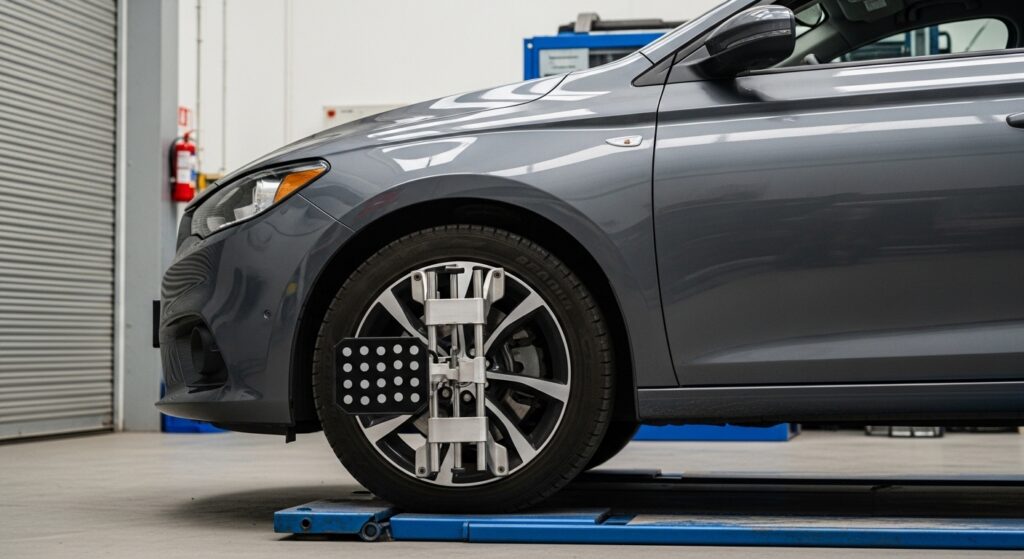
If you Google “how often should I get a wheel alignment,” you’ll find a dozen articles all saying the same thing: every 10,000 kilometres, or once a year. It’s clean advice. It’s simple. And in our experience running a workshop in Riverwood for over 12 years, it’s not quite right.
The truth is more nuanced, and we think Sydney drivers deserve an honest answer rather than a blanket recommendation that has more to do with generating bookings than actually protecting your tyres.
The Honest Answer: It Depends on How You Drive in Sydney
Here’s what 12 years of doing wheel alignments at Hot Tyres has taught us: some cars need alignment every 6 months. Others go two years without needing adjustment. The difference isn’t the car. It’s what the car drives over.
Sydney roads are rough. Not everywhere, but the routes that matter to most of our customers, Canterbury Road, King Georges Road, the Princes Highway through Rockdale and Kogarah, are full of potholes, uneven surfaces, and those raised iron plates where roadwork was done three years ago but never properly finished.
If your daily commute takes you along roads like these, your alignment takes a beating. We see cars come in from the Canterbury-Bankstown area that are out of alignment after just 8,000 kilometres because of the road surfaces alone.
On the other hand, if you mostly drive on the M5 and suburban streets in places like Oatley or Hurstville where the roads are in decent shape, your alignment might hold true for 20,000 kilometres or more.
Our Actual Recommendation
Rather than a fixed schedule, here’s what we tell our customers:
A check takes 10 minutes and at our workshop it’s free if you’re getting other work done. Even on its own, it’s inexpensive. The alignment itself, when it’s actually needed, costs around $79 to $99 at Hot Tyres for a standard passenger car as of April 2026. Luxury and performance vehicles with adjustable rear camber can run to $120–$150 because they take longer.
What Wheel Alignment Actually Is (In Plain English)
When we talk about wheel alignment, we’re adjusting three things:
Toe: whether your wheels are pointing slightly inward or outward when viewed from above. Think of it like your feet: standing with toes pointing out versus toes pointing straight ahead. This is the adjustment that affects tyre wear the most, and it’s the one that goes out of spec most often.
Camber: the tilt of your wheel when viewed from the front. If the top of the wheel leans outward, that’s positive camber. If it leans inward, that’s negative camber. A small amount of negative camber is normal and actually helps with cornering grip. Too much in either direction chews through tyres unevenly.
Caster: the angle of your steering axis. This one affects how your steering feels, whether it returns to centre after a turn and how stable the car feels at highway speed. Caster rarely goes out of spec unless you’ve had a significant impact.
When we do an alignment at Hot Tyres, we use a Hunter alignment machine that measures all three angles on all four wheels simultaneously. The machine compares your readings against the manufacturer’s specifications for your exact make and model, and we adjust until everything is within spec.
The 7 Warning Signs You Need an Alignment Now
Don’t wait for your next scheduled service if you notice any of these. Each one costs you money in tyre wear the longer you leave it:
1. Your car pulls to one side
If you’re driving on a flat, straight road and the car drifts left or right when you let go of the steering wheel briefly, your alignment is almost certainly out. Note: all roads in Sydney have a slight camber for drainage, so a very mild pull to the left on a suburban street can be normal. We’re talking about a noticeable, consistent pull.
2. Your steering wheel isn’t centred
If the steering wheel sits slightly crooked when you’re driving straight, the logo isn’t level, your toe alignment is out. This is one of the most common things we see at the workshop.
3. Uneven tyre wear
This is the big one, and it’s the reason alignment matters financially. Run your hand across the tread of each tyre. If one side is smoother than the other, that’s inner or outer edge wear caused by camber or toe being out of spec. We’ve seen brand new $200 tyres worn down on one edge in just 8,000 kilometres because of bad alignment. That’s an expensive lesson.
4. The steering feels loose or vague
If the steering doesn’t feel as responsive as it used to, like there’s a dead spot in the centre, or the car wanders slightly on the highway, alignment could be the cause. Though this can also indicate worn steering components, which we’d check during the alignment inspection.
5. Vibration through the steering wheel
While vibration is more commonly caused by wheel balance issues rather than alignment, severe alignment problems can cause a vibration or shimmy, especially at highway speeds. At Hot Tyres we always check both alignment and balance together because they’re related issues.
6. You just hit a pothole or kerb
That sickening thud when you hit a deep pothole on Canterbury Road at 60km/h? Your alignment almost certainly shifted. Even if the car seems to drive fine immediately after, get it checked. The misalignment might be subtle: not enough to feel in the steering, but enough to start wearing your tyres unevenly over the next few thousand kilometres.
7. After new tyres or suspension work
This isn’t optional. Any time you fit new tyres, you should get an alignment. And any time suspension components are replaced, shock absorbers, control arm bushings, tie rod ends, alignment must be done, because removing and refitting those parts changes the geometry.
At Hot Tyres, we include a free alignment check with every new tyre purchase. If adjustment is needed, we’ll let you know the cost before proceeding.
What Happens If You Ignore Wheel Alignment?
The most expensive consequence of bad alignment isn’t the alignment itself. It’s what it does to your tyres.
A car that’s 2 degrees out of toe alignment will scrub the equivalent of dragging your tyre sideways for 8.7 metres for every kilometre driven. Over 10,000 kilometres, that’s 87 kilometres of sideways scrubbing. That’s why misaligned cars can destroy a tyre in a fraction of its normal lifespan.
We had a customer last year come in from Punchbowl with a six-month-old set of Hankook Ventus tyres, $240 each, completely bald on the inner edge of both fronts. The rears were fine. A simple alignment check would have caught the problem at the three-month mark and saved him $480 in premature tyre replacement. The alignment adjustment itself would have been $89.
That’s the real maths: $89 for an alignment vs $480 in wasted tyres. And that’s not a hypothetical. It’s a real example from our workshop.
The Difference Between Alignment and Wheel Balancing
These get confused all the time. Here’s the simple version:
Wheel alignment = adjusting the angles of the wheels so they’re pointed correctly. This affects tyre wear and handling.
Wheel balancing = adding small weights to the wheel so it spins evenly. This affects vibration and ride comfort.
You can need one without needing the other. But at Hot Tyres, we check both whenever you come in for either service, because a vibration that seems like a balance issue sometimes turns out to be an alignment problem causing uneven wear that throws the balance off.
Wheel balancing costs around $15 to $20 per wheel at our workshop. We include it free when you buy new tyres from us.
Sydney Roads That Kill Your Alignment
Based on what we see from our customers across the Canterbury-Bankstown and St George areas, these are the roads that cause the most alignment issues:
If any of these roads are part of your daily commute, consider getting a check every 10,000 kilometres rather than 15,000.
What a Wheel Alignment Costs in Sydney (April 2026)
Prices vary across Sydney, and we think transparency matters:
| Service | Hot Tyres Price | Typical Sydney Range |
|—|—|—|
| 2-wheel alignment (front only) | $59 | $50–$80 |
| 4-wheel alignment (all four) | $89 | $79–$120 |
| Performance/luxury 4-wheel alignment | $120–$150 | $100–$180 |
| Alignment check only (no adjustment) | Free with service | $20–$40 elsewhere |
We always recommend a 4-wheel alignment over a front-only alignment. Modern cars have adjustable rear geometry, and if the rears are out, adjusting only the fronts can actually make things worse.
Frequently Asked Questions
Does wheel alignment affect fuel consumption?
Yes. Misaligned wheels create more rolling resistance, which means your engine works harder and uses more fuel. The difference is typically 3–7% depending on how far out the alignment is. On a car that uses $60 per week in fuel, that’s $2–$4 per week wasted. Over a year, that’s $100–$200 in extra fuel costs, more than the alignment itself.
Can I do a wheel alignment myself?
In theory, you can do a rough toe adjustment with string and a tape measure. In practice, no. Modern alignment requires a machine that measures angles to fractions of a degree. The equipment alone costs $30,000 or more. This is one job where DIY isn’t practical.
How long does a wheel alignment take?
At Hot Tyres, a standard 4-wheel alignment takes about 30 to 45 minutes. If there are seized adjusters or additional suspension issues, it can take longer, but we always let you know before we start.
Does lowering my car affect alignment?
Absolutely. Lowering springs or coilovers change the camber and toe geometry significantly. Any time you modify ride height, you need an alignment immediately after. We see a lot of modified cars in Riverwood and we always ask whether the suspension has been changed.
Should I get an alignment before or after new tyres?
After. The act of fitting new tyres can slightly shift alignment settings. Get the tyres fitted first, then align. That way the alignment is set with the tyres that will actually be on the car going forward.
—
Wheel alignment at Hot Tyres starts at $59. We’re at 74 Belmore Rd North, Riverwood NSW 2210: open Monday to Saturday. Walk-ins welcome, or call (02) 9533 2211 to book a time that suits you.