
A TPMS warning light on your dashboard is easy to dismiss, especially when the car still feels fine to drive. But it is one of the few dashboard warnings that maps directly to a safety issue you can check yourself in about two minutes. And in Sydney, where overnight lows and hot afternoon bitumen can swing tyre pressure across the threshold in a single day, it appears more often than most drivers expect.
The short version: a steady light usually means low pressure, a flashing light usually means a sensor fault. The longer version depends on which of seven causes you are dealing with. This guide covers what the TPMS warning light means, how to tell pressure problems from sensor problems, the fixes that actually clear it, and when it is worth booking a proper scan.
What’s in this guide
- TPMS warning light: the short answer
- What TPMS is and how it works
- Steady, flashing or intermittent: reading the pattern
- 7 causes of a TPMS warning light
- Is it safe to keep driving?
- How to fix it, step by step
- How Sydney temperatures trigger it
- Sensor replacement: what to know
- When to book a professional check
- Stopping it coming back
- Frequently asked questions
TPMS warning light: the short answer
Check the pressure in all four tyres cold, against the placard on the driver’s door jamb. If they were low, inflate them and the light should clear within a few minutes of driving. If the light stays on after correct inflation, or it flashed for a minute before going solid, you are looking at a sensor fault rather than an air problem, and that needs a scan.
That single distinction, pressure problem or sensor problem, decides everything else you do about a TPMS warning light. Most drivers skip it, add air, and end up back where they started.
What TPMS is and how it works
TPMS stands for Tyre Pressure Monitoring System. Most cars sold in Australia over the last decade use a direct system: a small battery-powered sensor sits inside each wheel, usually on the valve stem, measuring air pressure and often temperature. That data goes wirelessly to a receiver, which triggers the TPMS warning light once pressure in any tyre falls meaningfully below the manufacturer’s recommended setting. Typically around 25% under the placard figure.
| System type | How it measures | What a warning usually means |
|---|---|---|
| Direct TPMS | Physical sensor inside each wheel | Either low pressure or a failed sensor |
| Indirect TPMS | Estimates via ABS wheel-speed sensors | Almost always genuine low pressure |
Indirect systems are less precise and need recalibrating through a dashboard menu after any pressure adjustment. Unlike the United States and Europe, Australia does not currently mandate TPMS on new passenger cars. Most manufacturers fit it anyway because their vehicles are engineered for markets where it is required.
Steady, flashing or intermittent: reading the pattern
The icon looks like a tyre cross-section with an exclamation mark, sometimes shown as “(!)”. What matters is not the shape but the behaviour, so watch it through a full drive cycle rather than reacting to the first glance.
| What the light does | What it means | What to do |
|---|---|---|
| Comes on and stays steady | One or more tyres genuinely under-inflated | Check cold pressure, inflate to placard |
| Flashes 60–90 seconds at startup, then solid | System fault: dead sensor, no signal, or unrelearned wheel | Book a scan; adding air will not clear it |
| On when cold, clears after driving | Borderline pressure rising as tyres warm | Correct it now. It is low, not a false alarm |
| On straight after new tyres or a wheel swap | Sensors not relearned, or a non-sensored wheel fitted | Return to the fitter for a relearn |
7 causes of a TPMS warning light
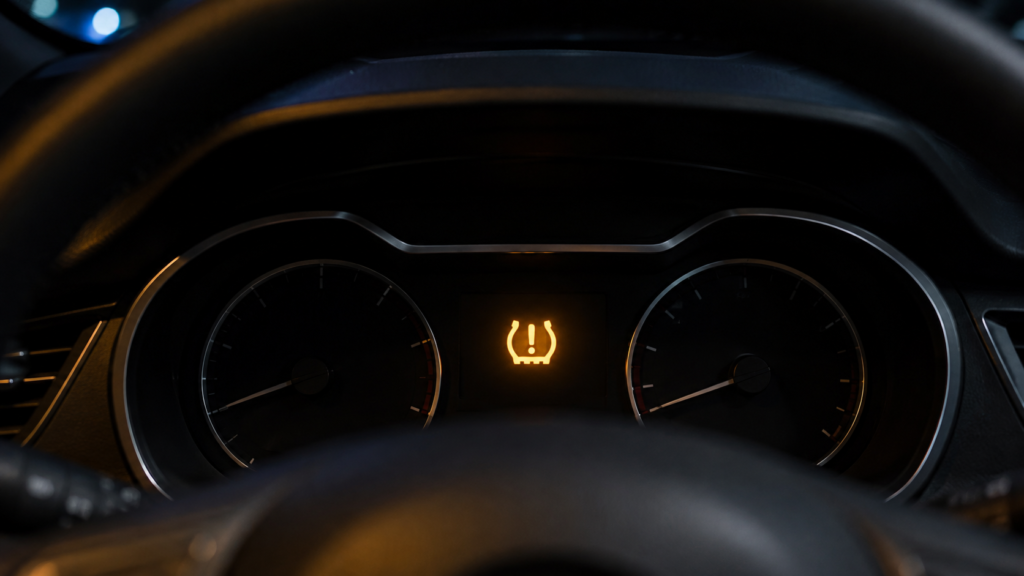
1. Genuine low tyre pressure
The simplest and most common cause. Normal air loss over several weeks, a slow puncture, or a leaking valve stem will all bring pressure down gradually until the light trips. Tyres lose a small amount of air naturally even with nothing wrong.
2. A cold snap after warm weather
Pressure drops roughly 1 psi for every 5–6°C the ambient temperature falls. A warm week followed by a cold morning is enough to trigger a TPMS warning light with no leak at all, the single most common reason it appears in Sydney’s cooler months.
3. A slow puncture or perished valve
A screw or nail can seal itself well enough to lose only a few psi a week. You will not feel it, but the system will see it. Rubber valve stems are a wear item and perish with age, which produces exactly the same slow loss.
4. A dead sensor battery
Each sensor runs on a sealed internal battery lasting roughly 7–10 years. When it dies the sensor stops transmitting and the system logs a fault rather than a pressure reading. This is the most common reason a TPMS warning light will not clear no matter how much air you add.
5. Sensors not relearned after a tyre or wheel change
Many vehicles need the system relearned after tyres are removed and refitted, or after swapping between alloy and steel wheels. Skipping this step leaves the light on even though every tyre is perfectly inflated.
6. A spare or non-sensored wheel fitted
If a spare without its own sensor has gone on after a puncture, most systems flag that wheel as missing a reading. The warning stays until the original wheel is back on the car.
7. Corrosion or physical sensor damage
Sensors fail from corrosion at the valve base, a cracked stem, or careless handling during fitting, and any of these will hold a TPMS warning light on. Coastal Sydney driving and salt exposure accelerate corrosion on aluminium valve stems in particular, which is why eastern and southern suburbs cars tend to see this earlier.
Is it safe to keep driving with the TPMS warning light on?
Do not ignore it, but there is no need to panic. Pull over when it is convenient and look for anything obviously wrong: a visibly flat tyre, a nail, or a bulge in the sidewall. Under-inflated tyres flex more than they should, which builds heat, wears the outer edges of the tread, and raises the risk of a sudden failure at speed. That risk peaks on a hot day at sustained highway speeds, which is exactly the M4 or M7 run where a blowout is least welcome.
How to fix a TPMS warning light, step by step
- Check all four tyres cold and compare against the placard on the driver’s door jamb or fuel flap: not the number moulded into the sidewall, which is a maximum rather than a recommendation.
- Inflate to the correct pressure and drive for a few minutes, since most systems need time to re-poll the sensors before the light clears.
- Check the spare if your vehicle carries a full-size sensored one, because some systems monitor it too.
- Watch the pattern on the next cold start. Steady means pressure. Flashing then solid means fault.
- Try the relearn procedure in your owner’s manual. Some cars have a reset button, some use a dashboard menu, some relearn automatically after a set distance.
- Do not just reset and ignore it. If the light returns within a drive cycle or two, resetting is hiding a real fault rather than fixing it.
- Get it scanned. A technician can read which specific sensor is faulting, check its battery status, and confirm whether it needs a relearn or a replacement.
For the manual side of this, gauges, correct figures and how often to check, our guide on how to check car tyre pressure walks through the process properly.
How Sydney temperatures trigger the TPMS warning light
Temperature is behind more TPMS warning light callouts than any other single cause. Air contracts as it cools, so the same tyre reads lower on a cold morning than it did on a warm afternoon. Nothing has leaked, the air has simply taken up less space. This catches people out every autumn.
| Temperature drop | Approximate pressure loss | Likely outcome |
|---|---|---|
| 5°C | About 1 psi | Usually unnoticed |
| 10°C | About 2 psi | Borderline on an already-low tyre |
| 15°C | About 3 psi | Enough to trigger the warning |
| 20°C | About 4 psi | Warning very likely |
The practical takeaway is to check pressures cold, before the first drive of the day, and to top up by a couple of psi heading into winter. If pressure checks have become a recurring chore, our tyre pressure check service covers both the manual check and whether a sensor fault is behind it.
TPMS sensor replacement: what Sydney drivers should know
Because sensor batteries have a finite life, a TPMS warning light caused by a dead sensor is a normal part of owning a car over the years rather than a sign anything was done wrong. A few practical points:
- Ask your fitter to check sensor condition whenever you get new tyres: the wheel is already off the car, so it costs nothing to look.
- Replacement cost depends on sensor type and whether reprogramming is needed, so ask for a quote rather than assuming a figure. It varies enough between makes that a generic number is not useful.
- A failing sensor rarely gives advance warning. Often the fault light is the first sign.
- If one sensor dies at seven or eight years old, the other three are the same age. Many owners replace the set to avoid three more separate visits.
- Fitting a full new set of tyres? Our tyre services page covers what a proper fitting includes, which is where sensor checks and relearning happen.
When to book a professional check
Book a scan rather than continuing to reset and ignore the TPMS warning light if any of these apply:
- It stays on after you have confirmed all four tyres are correctly inflated.
- It flashes at startup rather than staying steady.
- It appeared straight after new tyres, a wheel swap or a puncture repair.
- It clears and returns repeatedly over a few weeks.
- You are about to head out on a long trip and want it sorted beforehand.
Stopping the TPMS warning light coming back
- Check cold pressure monthly: before the first drive of the day, not after the school run.
- Adjust seasonally. Heading into winter, expect to add a couple of psi as ambient temperatures fall.
- Replace valve service kits with tyres. On sensored wheels the seal, nut and cap are inexpensive and prevent slow leaks.
- Use plastic valve caps on aluminium stems. Dissimilar metals accelerate corrosion.
- Note when sensors were last replaced, so a wave of faults does not surprise you in a single year.
The bottom line
The TPMS warning light is one of the more useful warnings on a modern dashboard, because it points at something specific and checkable rather than saying “see a mechanic” in vague terms. Check cold pressure monthly, note whether the light is steady or flashing, and if adding air does not clear it, treat that as a sign the sensor needs attention rather than the tyre.
Frequently asked questions
What does a flashing TPMS warning light mean versus a steady one?
A steady light usually means one or more tyres are genuinely under-inflated and need air. A light that flashes for 60–90 seconds after startup then stays on points to a system fault: commonly a flat sensor battery, a sensor that is not communicating, or a mismatch after a wheel swap. A flashing light should be scanned rather than fixed with air alone.
Is it safe to keep driving with the TPMS warning light on?
Treat it as a prompt to check your tyres as soon as it is safe to stop. Under-inflated tyres run hotter, wear unevenly and are more prone to a blowout, especially at highway speed. If you cannot inspect all four immediately, drive gently, avoid sustained high speeds and get them checked at the next opportunity.
Why is my TPMS warning light on when all the tyres look fine?
Visual inspection is unreliable below about 20% under-inflation, a tyre can be well under pressure and still look normal. Check with a gauge first. If all four are correct, you are most likely looking at a sensor fault, a relearn that was never done, or a non-sensored spare fitted to the car.
How much does it cost to replace a TPMS sensor in Sydney?
Cost varies by vehicle make, sensor type and whether reprogramming is required, so there is no single standard figure. Most tyre shops inspect sensor condition as part of a tyre change and can quote on the spot, worth asking before work begins rather than assuming a price.
How long do TPMS sensors last?
Typically 7–10 years, driven mainly by internal battery life, though this varies by manufacturer and how much the car is driven. The battery is sealed inside the sensor and cannot be replaced separately, so a flat battery means a new sensor.
Do tyre shops reprogram TPMS sensors after a tyre change?
Most professional fitters check and, where needed, relearn or reprogram sensors as part of a proper tyre change, since removing and refitting a tyre can disturb the sensor or valve stem. Confirm it is included when you book, particularly if wheels have been swapped or sensors serviced elsewhere.
Can I just disable the TPMS warning light?
Not advisable. It removes your only early warning of a slow leak, and a permanently lit dash warning can be queried at inspection or by a buyer later. Fixing the underlying cause is almost always cheaper than the blowout it exists to prevent.