
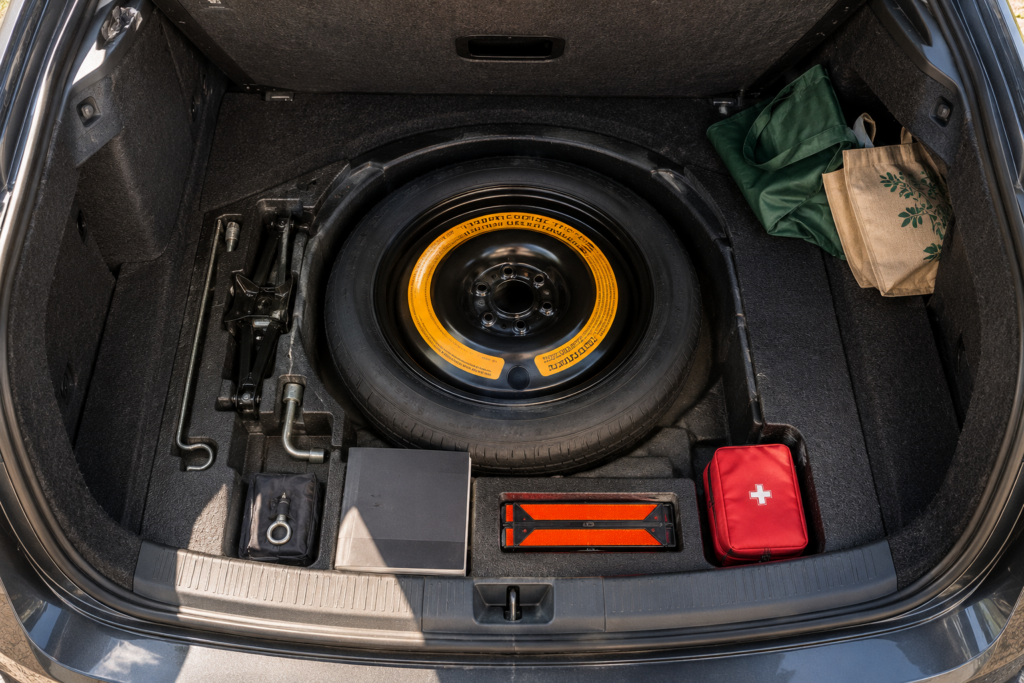
How far can you actually drive on a spare tyre? Most drivers assume “a while” and don’t think much beyond that. You hear the thump, pull over, find a flat, bolt on the spare, and head for the nearest tyre shop. The reality depends on which type of spare you actually have, what NSW road rules apply, and the condition of the spare itself.
This guide covers the practical limits of driving on a spare tyre in Australian conditions, the NSW-specific rules that apply, and how to recognise when the spare in your boot is itself a problem.
The three types of spare tyre and what each is designed for
Not all spares are the same. Knowing which type sits in your boot determines how far and fast you can safely drive.
Full-size matching spare
This is the same size, brand, model, and load rating as the four tyres on your vehicle. It looks identical to the others and is typically stored under the boot floor or under the rear of utes. A full-size matching spare is rated for normal driving at all speeds and distances. If you have one, you can technically drive on it indefinitely as if it were one of the regular four.
The catch: a full-size spare needs the same maintenance as your regular tyres. If it has been sitting in the boot for 6+ years, the rubber has aged regardless of tread depth. We cover tyre age limits in the section on spare condition further down.
Full-size non-matching spare
Some vehicles come with a full-size spare that matches the original equipment tyre but has different tread, brand, or model than your current replacement tyres. This is common on older vehicles whose owners have upgraded to performance or A/T tyres without replacing the spare.
Driving limits: short distances at normal speeds is fine. Long highway driving with a mismatched spare causes uneven wear on the differential and can affect ABS calibration in some vehicles. As a working rule, use it to get to the workshop and replace or rotate as soon as practical.
Space-saver (temporary) spare
The skinny tyre with the bright “TEMPORARY USE ONLY” warning on the sidewall. Designed to be small and light to save space and weight, not for sustained driving. Space-saver spares became standard on most passenger vehicles from the mid-2000s onward, and they have specific limits.
The general rule across most manufacturers: maximum 80 km/h, maximum 80 kilometres total distance. Some manufacturers permit up to 100 km/h or 120 km total; check your owner’s manual for the specific vehicle’s limits. The 80/80 rule is the safe default if you don’t have the manual handy.
The reason for the strict limits: the space-saver has a much smaller contact patch, lower load capacity, and different rolling diameter to your regular tyres. Driving longer or faster than the limits stresses the differential, affects handling in emergencies, and accelerates wear to the point of structural failure.
The NSW-specific rules that apply
Australian road rules around spare tyres are mostly nationally consistent, but a few NSW-specific points matter.
Speed limit on space-saver spares. NSW road rules adopt the manufacturer’s stated maximum speed for the spare. If your space-saver is labelled 80 km/h, driving above 80 km/h with it fitted is technically a road rules breach (the same way as driving with bald tyres). Police rarely enforce this proactively, but if you’re in an incident with the spare exceeding its rated speed, your insurance and liability position becomes more complicated.
Pink slip eSafety inspection. A vehicle that arrives for a pink slip inspection with a space-saver fitted does NOT automatically fail. The space-saver itself isn’t checked beyond a visual inflation and condition check. The inspector will note that the vehicle is operating on a temporary spare, but the inspection focuses on the four regular tyre positions. If the spare is fitted because one of your regular tyres has failed, you need to replace that regular tyre before the inspection unless you want to wait while it’s fitted.
Towing with a spare fitted. Towing significantly stresses the rear tyres, and a space-saver fitted to the rear axle is not rated for sustained tow loads. NSW road rules don’t specifically prohibit it but most vehicle manufacturers do. If you have a trailer attached and a space-saver fitted, don’t drive long distances; get the spare changed back to a full-size tyre before continuing.
Demerit points. Driving with worn tyres (below the 1.5mm legal minimum) is a 1-point offence in NSW with a $363 fine. The spare itself isn’t usually the issue here, but if you’ve forgotten the spare in the boot for years and it’s worn or rotten, the regulator may treat it as a worn-tyres breach if the spare is fitted.
What actually happens if you exceed the limits
It’s worth knowing what the failure mode looks like, because most drivers underestimate how quickly a space-saver degrades under sustained use.
At 100-120 km/h on a space-saver: The smaller diameter means the tyre is rotating about 10 to 15 percent faster than the other three. Heat builds up rapidly in the sidewall. Driving at this speed for more than 15 to 30 minutes risks sidewall blowout, which at highway speed can cause loss of control.
Beyond 80km total distance: The space-saver tread is much thinner than a regular tyre to begin with. Past 80km, the centre tread typically wears through to the structural belts. After the belts are exposed, the next phase is delamination or blowout. This isn’t a slow failure; it can happen suddenly.
Towing or carrying heavy load: Space-savers are typically rated at 200 to 300 kg load capacity per tyre versus 400 to 600 kg for full-size passenger tyres. Towing or full loads put the space-saver above its safe load rating, which causes sidewall flex damage even within the speed and distance limits.
Driving in heavy rain on a space-saver: The smaller contact patch significantly reduces grip in wet conditions, and the temporary tyre has less aggressive water-clearing tread. Hydroplaning risk on the spare is meaningfully higher than on a regular tyre.
How to recognise when your spare itself is the problem
The spare in your boot has been sitting there for as long as the vehicle has been on the road, unless you’ve specifically replaced it. Most drivers never check the spare until they need it, which is usually the worst time to discover it’s no good.
Tyre age (most important). Look at the four-digit DOT code on the sidewall of the spare. The last four digits indicate the week and year of manufacture (e.g. 2620 = week 26 of 2020). Any tyre older than 6 years should be considered for replacement regardless of tread depth. Rubber degrades chemically with age even when unused.
Inflation pressure. Check the spare’s pressure every time you do a regular tyre rotation (every 8,000 to 10,000 km). Space-savers are typically inflated to higher pressure than regular tyres (60 PSI is common). A space-saver that’s lost pressure over time is useless when you need it.
Visible cracking on the sidewall. Hairline cracks (called “ozone cracking” or “dry rot”) indicate the rubber has degraded. We have a full guide on what causes tyre dry rot for context. A spare showing visible cracks should be replaced before it’s needed.
Tread depth on the spare. If the spare has been used previously and was put back into the boot, it may have worn tread. Anything under 3mm on the spare is essentially useless as a safety reserve.
Damage from sitting under heavy boot loads. Tools, groceries, sports gear, and luggage compress the spare over years. A spare permanently dented or misshapen from sitting under weight is structurally compromised.
What to do if you get a flat in NSW
The sequence that works most reliably, assuming you’ve confirmed your spare is in good condition:
Pull over safely (off the road, on level ground, away from traffic flow). Activate hazard lights. Apply the handbrake firmly. If you’re on a freeway or busy road, call for assistance rather than changing the tyre yourself; the risk of being struck by traffic outweighs the inconvenience of waiting.
If conditions are safe to change the tyre, use the vehicle’s jack and wheel brace from the boot. Most modern vehicles include a jacking-point diagram in the owner’s manual; jacking at the wrong point can damage the chassis. Loosen the wheel nuts before lifting, raise the vehicle, remove the failed tyre, fit the spare, tighten by hand, lower the vehicle, then torque the nuts in a star pattern using full body weight on the brace.
Drive directly to a tyre shop. Don’t continue your original journey on a space-saver. If you’re more than 80 km from a workshop, call ahead to confirm they can fit you in; most workshops accommodate spare-tyre arrivals quickly because the safety risk of waiting is significant.
For mobile tyre replacement, our mobile tyre fitting service in Sydney can come to your location if the vehicle is in the Riverwood / St George / Canterbury-Bankstown area.
The case for run-flat tyres vs traditional spare
Some modern vehicles come with run-flat tyres instead of a spare. Run-flats allow you to drive 80 km at 80 km/h after a puncture without inflation, which is the same effective range as a space-saver spare. The trade-off: run-flats cost more, ride harder, and can only be repaired in limited circumstances.
Whether run-flats make sense depends on your driving patterns. For Sydney metro drivers who rarely venture outside service coverage, run-flats are convenient. For drivers regularly heading into regional NSW or doing long highway runs, a full-size spare in the boot is still the more reliable solution. We cover this in more detail in our run flat tyres guide.
Frequently asked questions
Can I drive on a space-saver if I’m under 80 km/h and just driving locally?
Yes, that’s exactly what they’re designed for. The 80 km/h speed limit and 80 km distance limit apply to single-trip use to get you to a tyre shop. Local driving under those limits is fine. Just don’t extend the use beyond the trip to get the regular tyre replaced.
What if my car doesn’t have a spare at all?
Many newer vehicles (particularly EVs and some performance cars) come with a tyre repair kit instead of a spare. The kit includes a sealant and a small compressor; you inject the sealant through the valve, inflate the tyre, and drive carefully to a workshop. Kits work for small punctures (under 6mm) on the tread surface; they don’t fix sidewall damage or large punctures. If your vehicle came with a kit and you have sidewall damage, you’ll need roadside assistance.
Is it OK to leave the spare in the boot for years without checking?
No. Even unused tyres degrade chemically over time. We recommend checking the spare’s inflation pressure annually (at the same service as the pink slip inspection works well) and replacing the spare entirely after 6 years regardless of use. Tyre safety inspections we offer include the spare in the check.
Can the spare be the new tyre after fitment?
Yes, with a caveat. Once you’ve used the spare and arrived at the workshop, the simplest path is usually to fit a new tyre to the damaged wheel and put the now-used spare back in the boot. If the failed tyre is repairable (small puncture, plug-and-patch), the workshop may repair it and you keep your original four-tyre set. The decision depends on the damage type; we cover repair limits in the tyre safety inspection page.
Does the spare need to be the same brand as my other tyres?
For a temporary space-saver, no. For a full-size spare used permanently as one of the four, ideally yes. Mixing brands across the same axle (front pair or rear pair) affects handling balance, particularly under emergency braking. Mixing across the front-and-back axles is less critical but still worth avoiding for performance vehicles.
What if I lose the wheel brace or jack from the boot?
Most service stations sell universal wheel braces and trolley jacks. The vehicle-specific lock-nut key for locking wheel nuts is harder to replace; contact your vehicle dealer for a replacement before you need it. Driving without the tools to change a tyre means you’ll need to call roadside assistance for any flat.
Don’t gamble on the spare: check it before you need it
The spare in your boot is your only safety reserve when a tyre fails. A spare that’s flat, aged, cracked, or worn isn’t a reserve at all. The 5-minute check at every service (or once a year minimum) is the difference between getting home and being stranded.
If you’re not sure of the condition of your spare, drop in to the Riverwood workshop. We can check the age, inflation, tread, and condition of any spare tyre at no charge as part of a regular service or pink slip inspection.