
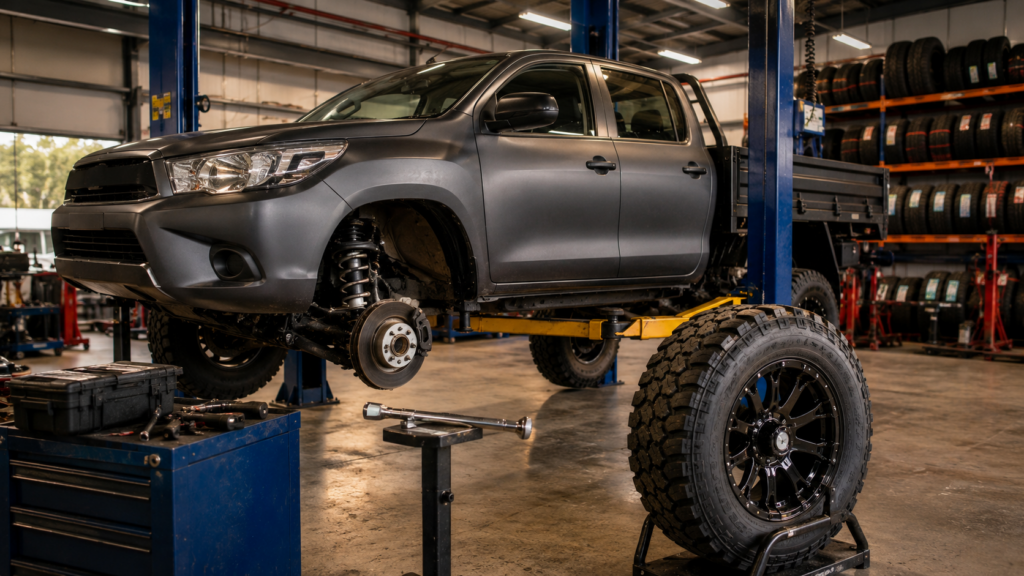
HiLux tyre upgrade decisions land on the same workshop bench week after week. The HiLux is the most upgraded ute on Australian roads, about one in three HiLuxes we see has been changed from factory tyre size at some point. Some of those upgrades work well; others cause problems that the owner only discovers months later when something starts wearing badly or the speedometer reads 15 percent off.
This guide covers what actually fits which generation of HiLux without modification, what needs a lift kit, what needs other suspension work, and the practical effects of going bigger that most upgrade guides don’t mention.
Match your generation first
HiLux tyre upgrade options depend on which generation you have. The wrong size for your generation either rubs at full lock, fouls the front guard at suspension droop, or sits oddly proportioned on the body.
HiLux N80 (2015 to 2024 8th generation)
The current-shape HiLux that most people picture. Factory tyre sizes vary by trim:
- SR, SR5, Rugged: 265/65R17 (overall diameter approx 745mm)
- Rugged X, Rogue: 265/65R17 (same)
- Earlier SR / Workmate variants: 245/65R17
The N80 is the most upgrade-friendly HiLux generation. Common practical upsizes:
- 285/70R17 gives 765mm overall diameter (~20mm taller). Fits without lift on most N80s. Mild rub at full lock on some variants; minor adjustment of the mudflap or factory plastic guard typically clears it. Speedometer error introduced: about 2.7 percent (negligible).
- 285/75R16 with 16-inch wheel swap gives the same overall diameter as 285/70R17 but more sidewall flex for off-road use. Fits without lift. Requires the wheel swap from the factory 17-inch.
- 33-inch tyres (33×12.50R17LT) at 838mm overall diameter (~93mm taller than factory) requires a 2-inch lift kit minimum to clear at full lock and full droop. Speedometer needs recalibration after fitment.
HiLux N70 (2005 to 2015 7th generation)
The previous-shape HiLux that’s still common, particularly in tradie fleets. Factory size: 265/65R17 on most variants, 245/70R16 on SR Workmate and earlier.
Common N70 upsizes:
- 265/70R17 gives 757mm overall diameter. Fits without lift on all N70 variants. Speedometer error negligible.
- 285/70R17 fits on most N70s but tighter clearance at full lock than on N80. Inspect carefully before committing.
- 33-inch tyres require 2-inch lift on N70 and front bash plate clearance check.
HiLux N60/N50 (pre-2005)
Older generations have smaller wheel wells and different suspension geometry. Upgrades depend heavily on specific year and trim. Worth coming into the workshop with the vehicle for a physical assessment rather than relying on generic upgrade charts.
Why the size you pick matters more than just looks
A common assumption is that “bigger tyres = better off-road, no real downside.” The reality is more complex. Every size jump affects four things measurably:
Fuel economy. Going from factory 265/65R17 to 285/70R17 typically increases fuel consumption by 0.3 to 0.6 L/100 km in normal driving. Going to 33-inch tyres typically increases it by 0.8 to 1.5 L/100 km. The extra rotating mass and the higher rolling resistance both contribute. Annual fuel cost increase for a HiLux driver doing 25,000 km per year: $200 to $600 depending on the size jump.
Speedometer accuracy. A taller tyre rotates more slowly for the same road speed. If your speedometer reads 100 km/h but you’re actually doing 107 km/h on 33-inch tyres without recalibration, that’s a real road-rules and speed-camera risk. NSW speed cameras and police radar measure actual ground speed, not your speedometer reading. Recalibration through the dealer is $80 to $150 and should be done after any upsize beyond +5 percent diameter.
Braking distance. Bigger tyres mean more mass to stop. The factory brakes were sized for the factory tyres. Upgrading to 33-inch tyres typically increases stopping distance by 4 to 8 metres at 100 km/h, depending on tyre compound and tread. This is rarely catastrophic but worth knowing if you’re moving from factory to large M/T tyres.
Drivetrain wear. Bigger tyres put more rotational stress on the differential, transfer case, axles, and wheel bearings. Manageable on N80 (newer drivetrain) for moderate upgrades; more of a concern on older N70 vehicles being upgraded beyond +1 size. The wear shows up over years rather than weeks, but it’s a real cost of the upgrade.
When you need a lift kit (and when you don’t)
The shortest answer: anything beyond +1 size from factory generally needs at least a 2-inch lift. Specifically:
No lift needed:
- Factory 265/65R17 to 285/70R17 (+20mm overall diameter): fits on most N80 HiLuxes without lift. Mild adjustment of factory mudflap or guard liner may be needed at full lock.
- Factory 245/65R17 to 265/65R17 (smaller variant to standard): no lift needed.
- 17-inch to 16-inch swap with equivalent overall diameter: no lift needed; this is purely a wheel-and-tyre repackaging move.
Lift needed (2-inch minimum):
- Any 33-inch tyre (33×12.50R17LT or equivalent): 2-inch suspension lift required to clear at full lock and full suspension travel.
- 285/75R16 on factory 17-inch HiLuxes: requires lift if not done with the wheel swap.
- 32-inch and larger Mickey Thompson or BFGoodrich M/T sizes on N70.
Bigger lift territory (3-inch or larger):
- 35-inch tyres: 3-inch suspension lift, body lift work, possible diff-drop kit, fender flares, custom guard work.
- This level of upgrade involves engineering certificate considerations for NSW registration and is beyond the scope of a “tyre upgrade” conversation. It becomes a full vehicle modification project.
For wheel alignment after fitting bigger tyres, see our companion guide on wheel alignment Sydney. Wheel alignment becomes more important, not less, after a size jump.
Tyre type choices for HiLux upgrades
The other half of the upgrade decision is tyre type. The off-road versus all-terrain choice we cover in detail in our best off-road tyres for a ute guide; the short version:
If the HiLux is mostly a daily driver with occasional weekend work: All-Terrain (A/T) tyres in the upsized size. They’re quieter, last longer, use less fuel, and handle wet sealed roads better than M/T. Our A/T buyer’s guide covers the brand picks.
If the HiLux genuinely does 50%+ off-road work: Mud-Terrain (M/T) tyres. Better on mud, sand, sharp rocks, and slow technical 4WD work, at the cost of road noise, fuel economy, and tread life.
For a HiLux that does highway-mostly with occasional dirt: Highway-Terrain (H/T) tyres in the upsized size. Often overlooked but the best fit for HiLuxes that rarely leave sealed road but want a tougher look.
Load rating matters more on a HiLux than most vehicles
HiLuxes get loaded. Tools, materials, camping gear, towed trailers, water tanks, tray-mounted gear. The factory tyres are LT-construction with appropriate load ratings, but aftermarket tyre choices can vary significantly.
For most N80 HiLuxes (3,000 kg GVM), you need LT (Light Truck) construction with a load index of at least 121 (1,450 kg per tyre at 80 PSI). For Rugged X and accessory-laden HiLuxes that approach 3,200 kg GVM, look at 124 load index minimum.
A passenger-rated (P-prefix) tyre will technically fit the wheel and look right, but it’ll squat under load, run hotter than rated, wear unevenly, and shred sidewalls on sharp rocks under weight. Don’t go below LT construction for a HiLux unless the vehicle is genuinely going to be empty most of its life.
The cost breakdown for typical HiLux upgrades
Real Sydney prices for the most common HiLux tyre upgrade combinations (fitted, balanced, wheel alignment included, May 2026):
Factory size replacement (265/65R17 A/T set of 4): $1,200 to $1,800 depending on brand. Mid-range options like Goodyear Wrangler AT, Bridgestone Dueler A/T sit at the lower end; premium options like BFGoodrich KO2, Toyo Open Country AT3 sit at the upper end.
+1 upsize (285/70R17 A/T set of 4): $1,600 to $2,400 fitted. The size jump adds 15-20 percent to per-tyre cost on most brands.
+1 upsize (285/70R17 M/T set of 4): $1,700 to $2,500 fitted. M/T pricing is in the same band as A/T at this size.
33-inch upgrade (33×12.50R17LT M/T set of 4): $2,200 to $3,200 for tyres fitted. Add $1,800 to $3,500 for a quality 2-inch lift kit installed. Total project: $4,000 to $6,700.
35-inch upgrade with 3-inch lift: $5,500 to $10,000+ depending on lift kit quality, custom work, and engineering certificate requirements.
For full pricing context across off-road tyre options, see the off-road ute tyres guide pricing table.
Common mistakes we see in the workshop
The same patterns come up repeatedly in HiLux upgrades that don’t work out:
Going too aggressive too fast. Owners who go straight from factory to 33-inch M/T tyres without working up through A/T or smaller M/T sizes often regret the road manners and fuel costs. The +1 A/T or +1 M/T upsize is the right step for most upgrades.
Skipping the wheel alignment after fitment. Bigger tyres dramatically affect camber and toe geometry. Fitting bigger tyres without a follow-up alignment leads to uneven wear that destroys the new tyres in 15,000-20,000 km instead of 50,000+ km. Wheel alignment is non-negotiable after any size change.
Skipping speedometer recalibration. A 33-inch HiLux without recalibration reads 100 km/h on the dash when actually doing 107-108 km/h on the road. That’s a real road-rules risk. $80-$150 at the dealer is cheap insurance.
Mixing 4WD-related modifications without coordination. Lift kit, tyre upgrade, snorkel, bash plates, suspension airbags. Each modification interacts with the others. Stacking them without a coherent build plan often leads to incompatibility issues that cost more to fix than to do right the first time.
Using passenger-rated tyres on a working HiLux. Cheap P-prefix tyres save a few hundred dollars upfront and cost the owner thousands in premature replacement and sidewall damage. Stick with LT construction.
Not factoring in pink slip implications. Heavy modifications (lift kits over 50mm, body lifts, custom flares) can require an engineering certificate for NSW pink slip inspection pass. Pure tyre upgrades within the manufacturer’s stated allowable range don’t trigger this requirement.
Frequently asked questions
What’s the biggest tyre I can fit on a stock N80 HiLux?
285/70R17 is the practical maximum without lift on most N80 HiLuxes. Some specific variants (early SR Workmate, narrow-track fleet versions) may have tighter clearance at full lock; come in for a physical check rather than relying on the chart alone. Anything beyond 285/70R17 needs at least a 2-inch lift.
Do I lose warranty if I upgrade my tyres?
Toyota’s standard warranty doesn’t void with HiLux tyre upgrades within the manufacturer’s allowed size range (the size matrix in the owner’s manual). Going significantly outside that range (more than +5 percent overall diameter without recalibration) can complicate warranty claims relating to drivetrain, ABS, and traction control. For most +1 upsizes within the chart, no warranty issue. For 33-inch and beyond, talk to your dealer before commitment.
What’s the speedometer error on common HiLux upsizes?
Factory 265/65R17 to 285/70R17: about 2.7 percent slower on the dash, so at actual 100 km/h, dash reads about 97. Factory to 33-inch (838mm vs 745mm): about 12.5 percent slower (at actual 100, dash reads about 87). The bigger upgrade definitely needs recalibration; the +1 upsize is borderline acceptable without.
Can I fit 33-inch tyres without a lift if I roll the guards?
Sometimes. Guard rolling buys you a few millimetres of clearance and can be enough on some HiLuxes for marginal fitment. The real issue isn’t usually static clearance though; it’s clearance at full lock during low-speed turning and at full suspension droop during off-road articulation. Guard rolling doesn’t fix those. The lift kit does.
What lift kit brand works best for HiLux upgrades?
For 2-inch lifts on N80 HiLux: TJM, Ironman 4×4, Old Man Emu (OME), and ARB are the four brands we fit most often. All four are well-engineered with good Australian support. Pricing is similar across them ($1,800-$3,500 fitted depending on shock and spring choice). The differences come down to ride preference (firmer vs more compliant) rather than capability.
Should I do tyres and lift kit at the same time?
Yes if you can. Fitting bigger tyres and then later adding a lift means you’ve potentially driven on rubbing tyres in the meantime, which can damage the sidewall or the guard liner. Doing both together at the workshop is also typically more cost-effective (single alignment, single fitment session).
Do mud-terrain tyres really need extra alignment?
Not extra in frequency, but the alignment specs matter more for M/T than for A/T or highway tyres. M/Ts wear more aggressively, so misalignment shows up faster as visible uneven tread. Get the alignment done immediately after fitment and again at 8,000 to 10,000 km to confirm the upgrade is holding the spec.
Talking through the right HiLux tyre upgrade for your build
The right HiLux tyre upgrade depends on what your HiLux actually does day-to-day. The same upgrade that’s perfect for a property owner doing weekend rock crawls is the wrong move for a tradie doing freeway runs to job sites every day. The N80, N70, and earlier generations all have different sweet spots within the same general upgrade options.
If you’re not sure which direction makes sense for your specific use case, drop in to the Riverwood workshop. We can look at the vehicle, talk through what you’re trying to achieve, and quote the right combination of tyre size, wheel choice, and lift kit if needed. Most upgrades take about a day in the workshop including alignment and recalibration.