
Replace a car tyre once the tread wears down to 1.5mm, which is the legal limit in NSW. Also replace it when you can see cracks, bulges or exposed cord, or when the tyre is around ten years old. Most tyres last 40,000 to 60,000km, but how and where you drive matters more than the number on the odometer.
Your tyres are the only thing connecting the car to the road. Once they’re worn, everything else gets worse with them: you stop slower, you slide in the wet, and you fail your pink slip. The good news is the warning signs are easy to read once you know what you’re looking at, and that’s what this guide covers.
Key takeaways
- The legal tread depth in NSW is 1.5mm, but replace a little earlier for safe wet-weather grip.
- Replace immediately for cracks, bulges, exposed cord, or age (around 10 years) regardless of tread.
- Most tyres last 40,000 to 60,000km; age matters as much as distance.
- Replace in pairs on the same axle; AWD and 4WD usually need all four matched.
- Read the four-digit date code on the sidewall to check a tyre’s age.
On this page
- The legal tread depth in NSW
- How to measure your tread at home
- Seven signs it’s time for new tyres
- What your wear pattern is telling you
- How long should tyres actually last?
- How to make your tyres last longer
- Do you have to replace all four at once?
- Worn tyres and your rego check
- What happens at a tyre check
- Frequently asked questions
The legal tread depth in NSW
The minimum legal tread depth in NSW is 1.5mm across the part of the tyre that touches the road. Below that the tyre is illegal, unsafe, and an instant fail on a pink slip. The number applies to the main circumferential grooves, all the way around and across the width, not just the deepest spot you can find.
Worth knowing: 1.5mm is already past the point where wet grip falls away. Tread exists to channel water out from under the tyre so the rubber can still touch the road in the rain. As the tread shrinks, that channelling gets weaker, and stopping distances on a wet road stretch out well before you reach the legal minimum. That’s why most drivers are better off replacing a bit before the limit than waiting to hit it.
How to measure your tread at home
You don’t need special tools. There are three easy ways to check.
- Find the wear-indicator bars. Look into the main grooves and you’ll see small raised bars of rubber running across them. When the surrounding tread wears down level with those bars, you’re at the 1.5mm legal limit.
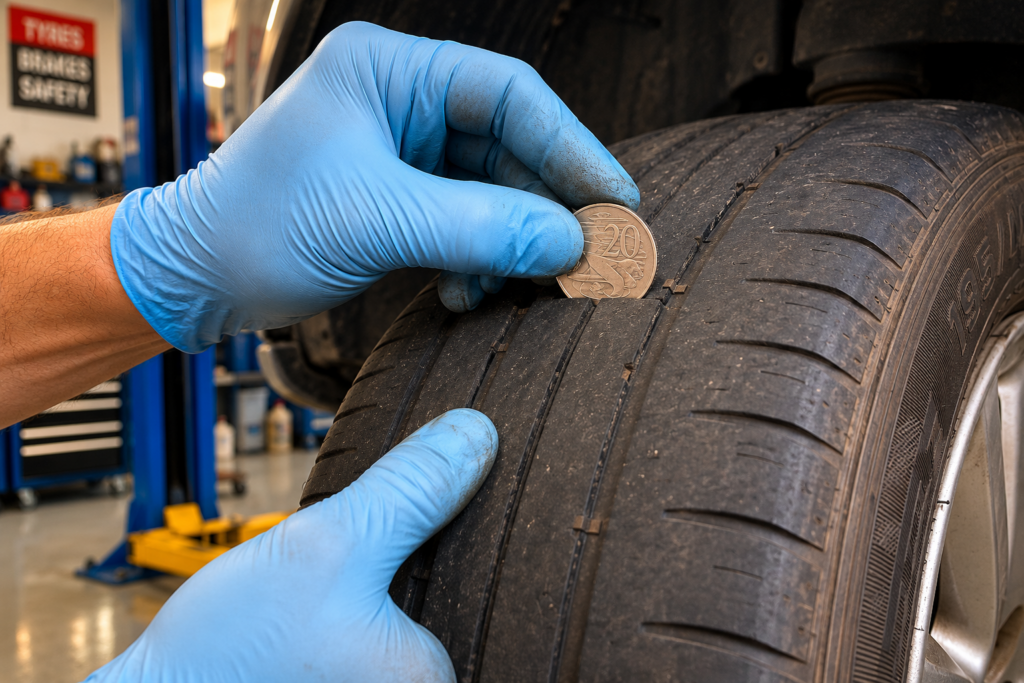
- Try the 20 cent coin test. Slot a 20c coin into the main groove. If the tread doesn’t reach the tip of the platypus’s bill, you’re down around 3mm, which is a sensible point to start shopping rather than waiting.
- Use a tread depth gauge. They cost a few dollars from any auto store and give you an exact figure. Check several spots across each tyre, because tread rarely wears evenly.
Check all four tyres, not just one. It’s common for the front pair to wear faster than the rear, or for one side to go quicker than the other, which is a clue in itself.
Seven signs it’s time for new tyres
You rarely get one big warning. It’s usually a few of these turning up together.
1. The tread is at or near 1.5mm
If the wear bars are showing or the 20c test fails, don’t put it off. This is the clearest signal there is.
2. Cracks in the sidewall or tread
Fine cracks, a dried-out look, or rubber that feels hard mean the tyre is perishing. It happens with age and sun exposure even when there’s plenty of tread left, and a car that lives outside in the Sydney sun ages its tyres faster. Perished rubber can let go without much warning.
3. Bulges or blisters
A bubble or bulge on the sidewall means the internal structure is damaged, usually after a hard kerb strike or hitting a pothole at speed. The air is now being held back by a weakened spot. That’s a replace-now problem, not a watch-and-wait one.
4. New vibration or noise
A steering wheel that shakes at highway speed, or a hum or thumping that wasn’t there last month, can point to uneven wear, internal damage or a balance issue. We explain what the different sounds mean in our guide to common tyre noises and their causes.
5. Uneven wear across the tyre
One edge bald while the rest looks fine means something is off, usually the wheel alignment or the tyre pressures. New tyres won’t fix the cause, so it pays to sort the underlying problem with a wheel alignment at the same time, otherwise the fresh set wears out the same way.
6. The tyre is simply old
Rubber ages whether you drive on it or not. Check the four-digit date code on the sidewall, where “2419” means the tyre was made in week 24 of 2019. Plenty of makers suggest replacing around 5 to 10 years old regardless of tread, especially on a car that mostly sits or only does short trips.
7. It keeps going flat
One repairable nail is fine. A tyre that keeps losing pressure, or has already been patched a few times, is past safe repair. If you’re not sure whether a puncture can be fixed or the tyre is done, we’ll assess it. See tyre repair and replacement.
What your wear pattern is telling you
How a tyre wears is a free diagnosis of the car. Once you know what to look for, you can catch a problem before it eats a whole set of tyres.
- Worn in the centre, fine on the edges: usually over-inflation. Too much air bows the tread so only the middle touches the road.
- Worn on both edges, fine in the centre: usually under-inflation. Too little air lets the shoulders take the load.
- Worn on one edge only: an alignment problem (camber or toe out of spec). This is the one a wheel alignment fixes.
- Cupping or scalloping (a wavy, dipped pattern): often worn suspension parts or a balance issue.
- Flat spots: hard braking or a car left parked in one position for a long time.
If you spot any of these, get the cause checked, not just the tyres. New rubber on a car that’s out of alignment is money down the drain.
How long should tyres actually last?
The 40,000 to 60,000km figure is a starting point, not a promise. A lot of Sydney driving is short suburban runs, stop-start traffic and hot summers, and all of that wears tyres faster than open-road kilometres. Hard cornering, heavy loads, skipped rotations and lazy alignment chew through them too. Two cars on the same model of tyre can end up 20,000km apart just from how they’re driven and looked after.
Age matters as much as distance. A tyre that’s done only 15,000km but is eight years old can be more dangerous than a younger tyre with more wear, because the rubber has hardened and lost grip. Distance and age together tell the real story.
How to make your tyres last longer
A few cheap habits add thousands of kilometres to a set.
- Keep the pressures right. Check them monthly, when the tyres are cold, against the figure on your car’s tyre placard (usually inside the driver’s door). Correct pressure is the single biggest factor in even wear and fuel economy.
- Rotate them. Swapping tyres front to back at regular intervals evens out the wear so the whole set lasts longer and you replace four at once instead of staggered pairs.
- Keep the alignment in spec. A knock from a kerb or pothole can throw it out, and you’ll wear an edge off a tyre in no time.
- Drive a bit gentler. Hard launches, late braking and fast cornering all scrub rubber off faster than smooth driving.
Do you have to replace all four at once?
Not always, but match them sensibly. Replace tyres in pairs on the same axle so grip is even side to side, and put the newer pair on the rear for steadier handling in the wet, even on a front-wheel-drive car. AWD and 4WD vehicles are stricter again: many need all four at a similar tread depth, because mixing badly worn and brand new tyres can strain the drivetrain and confuse the system that splits power between the wheels. Check what your car needs before buying just one.
Worn tyres and your rego check
Tread under 1.5mm, cord showing, bulges and bad cracking are all automatic fails on a pink slip. If your rego is due, it’s cheaper to sort the tyres first than to fail, fix and come back for a re-inspection. We walk through the whole process on our pink slip inspection page.
What happens at a tyre check
If any of this sounds like your car, drop into the Hot Tyres workshop in Riverwood. We’ll measure the tread depth across all four tyres, read the date codes, look over the wear pattern and sidewalls, and check the pressures. Then we’ll tell you straight whether you’ve got months left or need a set now. There’s no pressure to buy on the spot. When you do need them, there’s a full range on our new tyres page, and we’ll fit and balance them while you wait.
Frequently asked questions
What is the legal tyre tread depth in NSW?
1.5mm across the tread that contacts the road. Below that the tyre is illegal and will fail a pink slip. For wet-weather safety, most drivers should replace before reaching the limit.
How often should I replace my car tyres?
Most last 40,000 to 60,000km, but it depends on driving style, alignment and conditions. Also replace any tyre around 5 to 10 years old regardless of tread, because the rubber perishes with age.
Can I replace just one tyre?
Sometimes, but it’s best to replace in pairs on the same axle so grip is even. AWD and 4WD vehicles usually need all four at a similar tread depth to avoid drivetrain strain.
How do I check tyre tread without tools?
Use a 20 cent coin in the main groove; if the tread doesn’t reach the tip of the platypus’s bill, you’re getting low and should plan to replace. Also check the wear-indicator bars in the grooves.
Do tyres expire even if I don’t drive much?
Yes. Rubber ages and cracks over time, so a low-kilometre tyre can still be unsafe if it’s old. Check the four-digit date code on the sidewall and have older tyres inspected.
What causes uneven tyre wear?
Usually incorrect tyre pressure or wheel alignment that’s out of spec. Worn suspension parts can also cause a cupped, wavy pattern. Fix the cause when you fit new tyres, or they’ll wear the same way.
Written by the team at Hot Tyres, a tyre fitting and auto repair workshop at 74 Belmore Rd North, Riverwood NSW, serving Sydney drivers for over a decade. For advice on your specific car, drop into the workshop and we’ll take a look.