
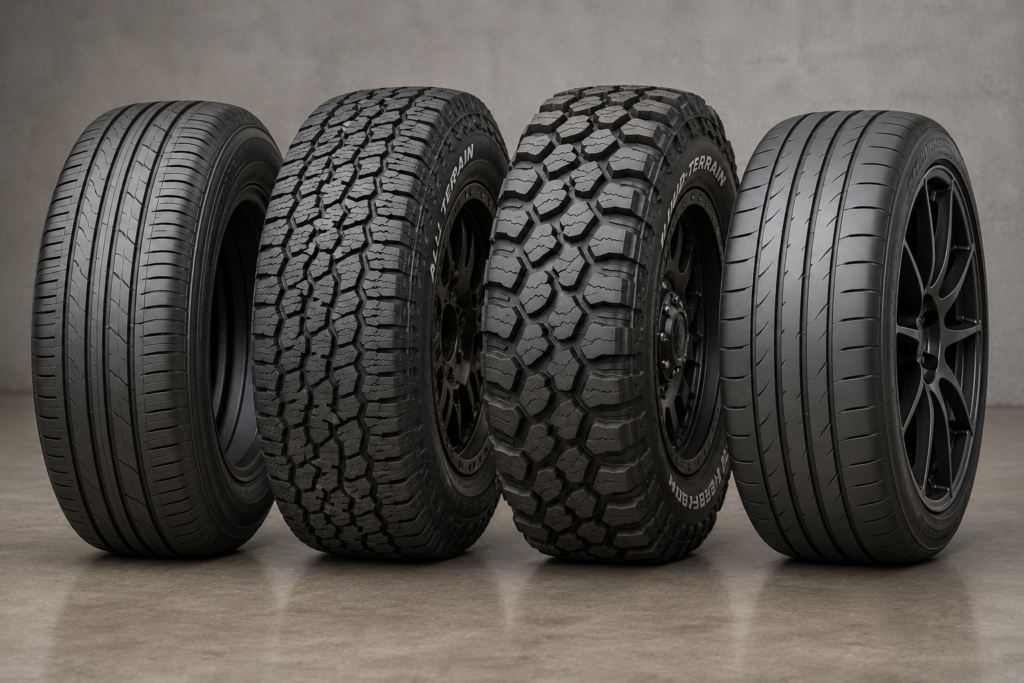
Car tyres are sorted three ways: by the conditions they’re built for (summer, all-season, all-terrain, mud-terrain), by the vehicle they suit (passenger, SUV, 4WD, performance, light commercial), and by how they’re built (tubeless, run-flat, self-sealing). Most cars sold in Australia run tubeless all-season or summer tyres.
Standing in front of a wall of tyres and feeling none the wiser is a common experience. This is the map. We’ll go through each group, explain who each type suits, show you how to read the code on the sidewall, and link off to the detail where it helps.
Key takeaways
- Tyres are grouped by conditions, by vehicle, and by construction.
- Most Australian cars run tubeless all-season or summer tyres.
- Match the size, load rating and speed rating to your car’s tyre placard.
- EVs need tyres rated for the extra weight, with low rolling resistance and quiet running.
- Don’t mix tyre types, brands or tread depths across an axle.
On this page
Tyre types by the conditions they handle
This is the split most Sydney drivers care about.
- Summer tyres use a softer compound for grip in warm and wet weather. They suit most of the year here and feel sharp and responsive on the road. Snow and near-freezing temperatures aren’t their strength, which rarely matters for a Sydney car.
- All-season tyres give up a little outright grip for steady performance across the whole year. A safe default if you want one set fitted and then forgotten about.
- All-terrain (AT) tyres mix road manners with light off-road and gravel ability. They’re a good fit for utes and 4WDs that see dirt roads and the odd campsite but live mostly on bitumen. We put them head to head in AT tyres vs HT tyres.
- Mud-terrain (MT) tyres have big aggressive tread blocks for serious off-road work. They’re loud on the highway and wear faster on sealed roads, so they only make sense if you genuinely go bush often.
- Winter tyres exist for cold climates with snow and ice. In most of Australia you’ll never need them, but they’re worth knowing about if you head to the snow each year.
Tyre types by the vehicle they suit
Tyres are engineered around the weight, speed and job of different vehicles.
- Passenger car tyres are tuned for comfort, quiet and fuel economy on everyday hatches and sedans.
- SUV and 4WD tyres carry more weight and have to deal with a higher centre of gravity, so getting the right one matters more here. If you’ve got a 4WD, start with our pick of the best 4×4 tyres in Australia.
- Performance tyres use grippier compounds and stiffer sidewalls for sharper steering response and higher speed ratings. Worth it on a sporty car, overkill on a commuter. More in performance tyres for sports cars.
- Light commercial (LT) tyres are built tougher, with stronger sidewalls, for vans and work utes that carry heavy loads all day.
A note on EV tyres
Electric cars are heavier than petrol equivalents because of the battery, and they deliver torque instantly, both of which wear tyres faster. They’re also quieter, so tyre noise stands out more. EV-specific tyres are built with stronger construction to handle the weight, low rolling resistance to protect range, and noise-reducing foam inside. If you drive an EV, it’s worth fitting tyres rated for it rather than a standard set.
Tyre types by how they’re built
Under the tread, the internal construction differs too.
- Tubeless tyres seal air against the rim with no inner tube. This is what almost every modern car runs, and there’s a full breakdown in tube vs tubeless tyres.
- Tube-type tyres hold air in a separate inner tube. You’ll mostly see these on older vehicles, trailers and some bikes.
- Run-flat tyres have reinforced sidewalls that let you drive a short, limited distance after a puncture instead of stopping on the roadside. Handy on cars sold without a spare.
- Self-sealing tyres line the inside of the tread with a sealant that plugs small punctures as they happen, so you often don’t lose any pressure. How that works is in self-sealing tyres explained.
How to read the sidewall
The string of numbers and letters on the side looks like code, but it’s just a spec sheet. Take 225/45 R17 94W as an example:
- 225 is the tyre width in millimetres.
- 45 is the aspect ratio, the sidewall height as a percentage of the width. A lower number means a lower-profile tyre.
- R means radial construction, which is standard on modern car tyres.
- 17 is the wheel diameter in inches that the tyre fits.
- 94 is the load index, a code for how much weight the tyre can carry.
- W is the speed rating, the maximum speed the tyre is built for.
Fitting the wrong size, or a lower load or speed rating than your car needs, is unsafe and can fail rego. If it still reads like code, our guide to tyre load ratings breaks it down further. The safest move is to match the figures on your car’s tyre placard, usually inside the driver’s door, or just ask us.
How to choose the right tyre for you
For most Sydney drivers, an all-season or summer passenger tyre in the correct size does the job perfectly well. Step up from there based on what you actually do:
- Tow a caravan or boat, or carry loads: a light commercial or load-rated tyre.
- Head off the bitumen onto gravel and dirt tracks: an all-terrain tyre.
- Drive a sporty car and want sharper handling: a performance tyre.
- Drive an EV: a tyre rated for the extra weight and quiet running.
Budget matters too, and a mid-range tyre from a reputable maker is usually the sweet spot for everyday driving. Tell us what you drive and how you use it and we’ll match it. Have a look at our new tyres page or come into the Riverwood workshop.
Can you mix different tyres?
It’s best not to. Mixing tyre types, brands or tread depths across an axle gives you uneven grip, which can make the car behave unpredictably under braking or in the wet. If you can’t replace all four at once, at least keep matching tyres on the same axle and put the newer pair on the rear. On AWD and 4WD vehicles, mismatched tread depths can also stress the drivetrain, so those usually want a full matching set.
Frequently asked questions
What are the main types of car tyres?
By condition: summer, all-season, all-terrain and mud-terrain. By vehicle: passenger, SUV/4WD, performance and light commercial. By construction: tubeless, tube-type, run-flat and self-sealing. Most modern cars use tubeless all-season or summer tyres.
What’s the difference between all-season and summer tyres?
Summer tyres give sharper grip in warm and wet weather, while all-season tyres trade a little grip for steady year-round performance. In Sydney’s climate either works for everyday driving.
What tyres are best for an SUV or 4WD?
It depends on use. Highway-terrain or all-season tyres suit SUVs that stay on sealed roads; all-terrain tyres suit utes and 4WDs that see gravel and dirt; mud-terrain only for serious off-road.
Do electric cars need special tyres?
EV-specific tyres are recommended. They’re built for the extra battery weight and instant torque, with low rolling resistance to protect range and noise reduction for quieter cabins.
How do I know what tyre size my car needs?
Check the tyre placard (usually on the driver’s door jamb) or the sidewall of your current tyre, which shows the size, load rating and speed rating. Match these exactly, or ask a fitter.
Written by the team at Hot Tyres, a tyre fitting and auto repair workshop at 74 Belmore Rd North, Riverwood NSW, serving Sydney drivers for over a decade. Not sure which tyre suits your car? Drop into the workshop and we’ll help you choose.