
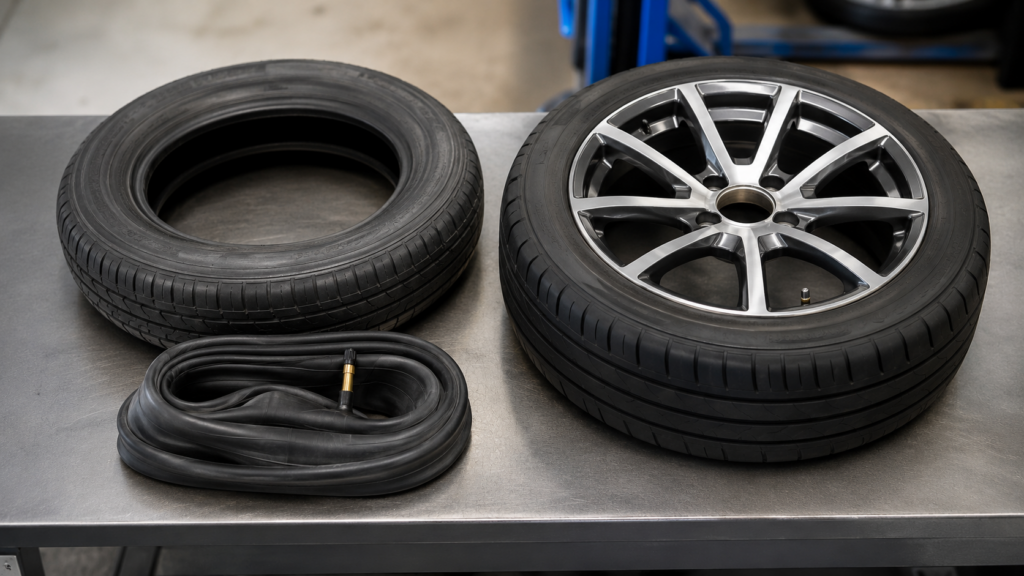
When it comes to tube vs tubeless tyres, the difference comes down to one thing: a tube-type tyre holds its air in a separate inner tube, while a tubeless tyre seals the air against the wheel rim itself with no tube inside. Nearly every modern car, SUV and most motorbikes sold in Australia use tubeless tyres, because they deflate more slowly and are easier to repair.
If you’re not sure which you’ve got, or which to choose for a trailer or an older vehicle, here’s the plain version with all the detail you need.
Key takeaways
- A tube-type tyre holds air in a separate inner tube; a tubeless tyre seals against the rim with no tube.
- Almost all modern cars, SUVs and most motorbikes in Australia are tubeless.
- Tubeless is safer for road use: it loses air gradually after a puncture instead of suddenly.
- Tubeless tread punctures are repaired from the inside with a plug-and-patch.
- Check the valve and sidewall to tell which type you have.
On this page
How each one works
A tube-type tyre has a rubber inner tube that inflates inside the tyre and presses against the rim. The tube holds the air; the tyre is mostly the outer shell that protects the tube and grips the road. To inflate it, the valve is part of the tube itself, poking out through a hole in the rim.
A tubeless tyre has no tube. The air sits directly inside the tyre, and it’s kept there by two things working together: an airtight rubber inner liner bonded to the inside of the tyre, and a tight seal between the tyre’s bead (its inner edge) and the rim. The valve is fitted straight into the rim rather than into a tube.
How a tubeless tyre seals to the rim
This is the clever part. The rim has a small raised ridge, and when the tyre is inflated, air pressure pushes the bead of the tyre firmly against that ridge and the rim flange, forming an airtight seal all the way around. That’s why a tubeless tyre has to be fitted to a rim designed for it, and why a damaged or corroded rim can cause a slow leak even when the tyre itself is fine. When we fit tubeless tyres we clean the bead seat and check the rim seals properly, because a poor seal is a common cause of a tyre that mysteriously loses pressure.
How they compare
When you weigh up tube vs tubeless tyres for everyday driving, tubeless wins on most counts. When it picks up a nail it tends to leak slowly, which gives you time to react, whereas a tube can deflate fast because it tears around the hole. Tubeless punctures in the tread are usually quicker to plug and patch from the inside, while a tube-type means removing the tyre to fix or replace the tube. Tubeless also runs a touch lighter and cooler, which helps both wear and fuel use. Tube-type still shows up on older vehicles, some trailers, wheelbarrows, bikes and heavy machinery, where the simpler setup suits the job.
Which is safer?
For normal road driving, tubeless has the edge. Because the air isn’t trapped in a tube that can rupture, a tubeless tyre usually loses pressure gradually after a puncture instead of going flat in seconds. That slower deflation gives you more control and more time to pull over safely, rather than a sudden flat at speed. It’s a big part of why the whole car industry shifted to tubeless decades ago, and why it’s now the standard on virtually every new car.
Can you put a tube inside a tubeless tyre?
In some cases a tube can be fitted into a tubeless tyre as a temporary measure, for example on certain older rims or to limp a setup along. It’s not ideal, though. The combination can run hotter because the tube and the tyre’s inner liner rub against each other, and it isn’t designed to work together for the long haul. The reverse, running a tube-type tyre without a tube, is a definite no. If you’re considering either, talk to a fitter first rather than relying on it as a permanent solution.
What’s on most cars, and how to tell
If your car was built in the last few decades, it’s almost certainly tubeless. The quickest check is the valve: a tubeless valve sits firmly in the rim and feels solid when you wiggle it, while a tube-type valve is part of the tube poking through and can feel slightly looser. Many tubeless tyres also have the word “tubeless” moulded into the sidewall. Not sure? We can tell you in seconds when you’re in.
Getting a puncture sorted
Tube or tubeless, a puncture should be assessed properly rather than just plugged and forgotten, especially if it’s near the sidewall or the tyre was driven on while flat. A proper repair on a tubeless tyre is done from the inside, with the tyre removed and a combined plug-and-patch fitted, not just a string plug rammed in from outside. We’ll check whether yours is safely repairable on our tyre repair and replacement page, and if it’s time for a fresh set you can browse new tyres or read our guide to the types of car tyres.
Frequently asked questions
What is the difference between tube and tubeless tyres?
A tube-type tyre holds air in a separate inner tube, while a tubeless tyre seals air directly against the rim with no tube. Tubeless deflates more slowly when punctured and is easier to repair.
Are most car tyres tubeless?
Yes. Almost all cars, SUVs and most motorbikes sold in Australia in recent decades use tubeless tyres. Tube-type is now mostly found on older vehicles, trailers and some bikes.
Which is safer, tube or tubeless?
Tubeless is generally safer for everyday driving because it loses air gradually after a puncture rather than deflating suddenly, giving the driver more time to react.
Can you put a tube in a tubeless tyre?
A tube can be fitted as a temporary measure in some cases, but it isn’t ideal because the combination runs hotter and isn’t designed for long-term use. Check with a fitter first.
How do I know if my tyres are tubeless?
Check the valve, which sits firmly in the rim on a tubeless setup, and look for the word “tubeless” moulded into the sidewall. If you’re unsure, a tyre shop can confirm it instantly.
Written by the team at Hot Tyres, a tyre fitting and auto repair workshop at 74 Belmore Rd North, Riverwood NSW, serving Sydney drivers for over a decade. Not sure what’s on your wheels? Drop in and we’ll check.