
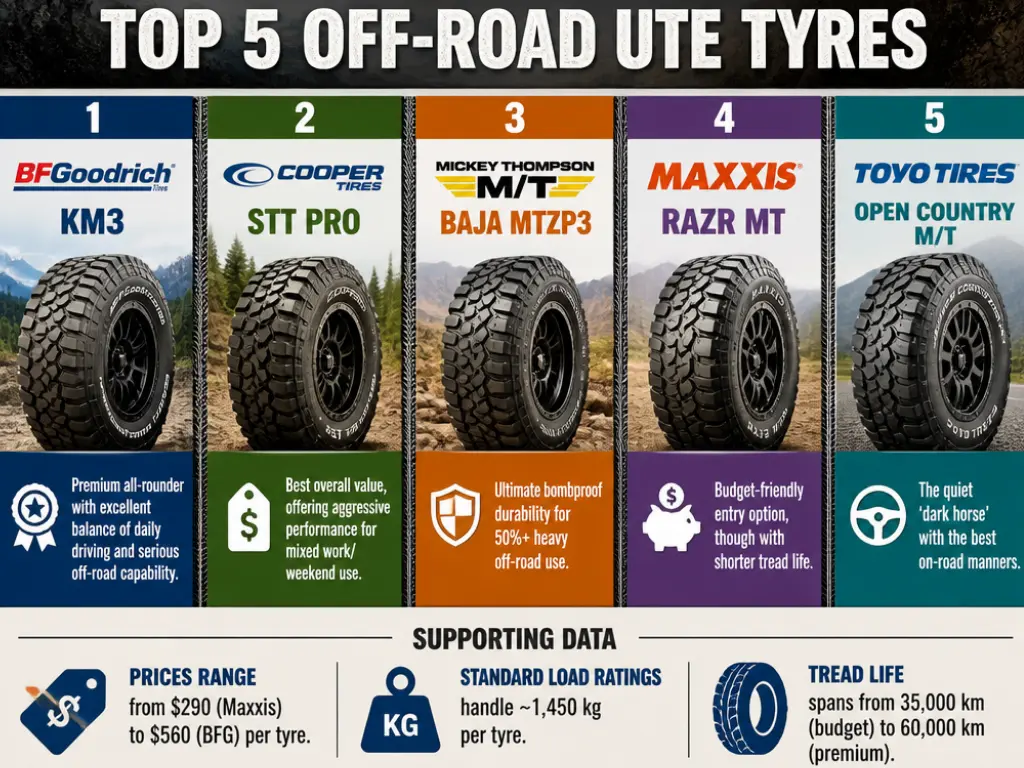
If you’ve Googled this question you’ve already noticed the same thing we have at the workshop: most “best off-road ute tyre” lists are written by people who’ve never bolted a tyre onto a HiLux. They list every tyre in every category and tell you to “pick what suits your needs” which is useless when you’re standing in a tyre shop with a budget of $1,500 to $2,500 and a tray to keep loaded for work.
So here’s the version we wish existed when our customers ask. Five mud-terrain (M/T) tyres we actually fit to utes most weeks, ranked by what they do well, what they don’t, and what they realistically cost on a fitted-out HiLux, Ranger, Triton, D-MAX, BT-50, or Amarok in Sydney.
Before we get into the picks, two things worth being clear on.
Off-road, all-terrain, what’s the actual difference?
People use these phrases interchangeably and shouldn’t. The categories matter because they change how the tyre wears, how loud it is on the M5, how much fuel it uses, and how grippy it is on a wet roundabout in Bankstown.
– All-terrain (A/T) tyres are the hybrid. They’re engineered to do 80–90% of their work on sealed road and 10–20% on dirt, gravel, sand, and light mud. They’re quieter, last longer (60,000–80,000 km is normal), use less fuel, and handle rain on bitumen well. If your ute spends most of its life on the highway and weekends on fire trails, this is your category. We covered the A/T picks in our [best all-terrain tyres Australia guide](https://www.hottyres.com.au/best-all-terrain-tyres-australia-2026-buyers-guide/).
– Mud-terrain (M/T) tyres are the off-road specialists. Aggressive blocky tread, deep voids between the lugs, reinforced sidewalls. They’re loud (think 5–8 dB louder than A/Ts at 100 km/h), they wear faster (40,000–55,000 km if you’re lucky), they cost you 10–15% more in fuel, and they’re noticeably skittier in the wet on sealed road. What you get back is genuine performance in deep mud, soft sand, sharp rocks, and slow technical 4WD work where an A/T just spins.
If your ute is doing real off-road work, properties, mine sites, beach driving, true high-country tracks, you want M/T. If you spend more time on the M5 than off it, an A/T will serve you better and your ears will thank you.
This guide is for the M/T side of that decision.
The other thing, load rating actually matters on a ute
A passenger-car SUV doesn’t need to think about this much. A loaded ute does. If you carry tools, drag a trailer, or run a canopy with camping gear in the tray, your tyres are working harder than the showroom-spec set the ute came with.
Look at the load index on the sidewall. For most modern dual-cab utes (3,000–3,500 kg GVM), you want LT (Light Truck) construction with a load index of at least 121 (1,450 kg per tyre at 80 PSI). A passenger-rated tyre with a P prefix will technically fit, but it’ll squat under load, run hotter, wear unevenly, and chew through sidewalls if you grind a rock with weight on the tray.
Every M/T we’d recommend for a ute is LT-construction. We’ll flag the load index next to each pick.
Our 5 picks for off-road ute tyres in 2026
1. BFGoodrich Mud-Terrain T/A KM3
The default we recommend when a customer says “I want serious off-road but I still drive to Penrith every day.”
– Common ute sizes: 265/65R17, 285/70R17, 285/75R16, 33×12.50R15LT
– Load index (typical 17): 121/118R (1,450 kg per tyre)
– Sydney price (fitted, balanced, with valve and disposal): $480–$560 per tyre depending on size
– Set of 4 fitted, balanced, aligned: $2,050–$2,400
The KM3 has been around since 2018 and replaces the KM2 most workshops still talk about. The improvements over the previous generation are real: linear flex zone in the sidewall (better grip on rocks at low pressure), interlocking tread design (sheds mud faster), and a noticeably less aggressive on-road feel than older M/Ts. They’re still louder than an A/T, but in a way that fades into the background after the first month.
What we like: fitting them is easy (sit on the rim properly first try, no bead arguments), they balance with sensible weight (we’ve never needed more than 60 g per wheel), and the wear is even when alignment is correct.
What’s not great: the price. This is the premium pick in the M/T category, and Cooper does almost as well for less. If budget is a real constraint, the Cooper is the smarter buy.
2. Cooper Discoverer STT Pro
Better value than the BFG for 80% of the performance. The customer favourite for tradies running utes as work vehicles plus weekend off-roaders.
– Common ute sizes: 265/70R17, 285/70R17, 285/75R16, 33×12.50R15LT
– Load index (typical 17):121/118Q (1,450 kg per tyre)
– Sydney price (fitted, balanced, with valve and disposal): $390–$460 per tyre
– Set of 4 fitted, balanced, aligned: $1,700–$2,050
The STT Pro is a serious tyre dressed up as a budget option. The tread is genuinely aggressive (deeper voids than the BFG KM3 if you measure them), the three-ply sidewall is reinforced for sharp rock work, and Cooper’s silica compound grips wet sealed road better than most M/Ts in this price bracket.
What we like: the price-to-performance ratio is the best in this guide. We’ve fitted hundreds of these to local builders’ utes that haul tools five days a week and crawl rocks on weekends. They handle that mixed life better than any tyre at this price.
What’s not great: noisier than the BFG above 90 km/h, and the tread blocks chip more easily on rough bitumen than the silica-heavy BFG compound. Not a deal-breaker, but worth knowing.
3. Mickey Thompson Baja MTZP3
The tyre to pick if your ute is genuinely doing 50%+ off-road. Built to take a hit.
– Common ute sizes:285/70R17, 285/75R16, 33×12.50R15LT, 35×12.50R17LT
– Load index (typical 17): 121/118Q
– Sydney price (fitted): $440–$520 per tyre
– Set of 4: $1,900–$2,250
Mickey Thompson is what you fit when you’ve broken sidewalls on softer M/Ts and you want something that won’t. The MTZP3 has the most aggressive tread of anything in this guide, sidewall biters that genuinely grip on rock crawls, and a compound formulated for cut-and-chip resistance.
What we like: bombproof construction. We’ve replaced very few of these from physical damage compared to softer M/T compounds. Customers running NSW north coast tracks, Vic high-country, or remote-area work properties love them.
What’s not great: heavy. They add real rotating mass which you’ll feel in fuel economy (we’ve seen ute owners report 0.5–1.0 L/100 km worse than equivalent BFG/Cooper) and in initial acceleration. Not a tyre to fit if your ute mostly sits on the M5 between job sites.
4. Maxxis Razr MT (MT-772)
The price-conscious pick. Half the cost of premium M/Ts, and for the right driver, plenty of tyre.
– Common ute sizes: 265/70R17, 285/70R17, 33×12.50R15LT
– Load index (typical 17): 121/118Q
– Sydney price (fitted): $290–$360 per tyre
– Set of 4:$1,250–$1,550
Maxxis sits in a different price tier and most pretend it’s because of “compromised quality.” It’s not. It’s because Maxxis manufactures at scale in Asia without the marketing premium of US brands. The Razr MT is a solid tyre that does the M/T job competently, with a few real trade-offs you should know about.
What we like: budget-friendly fitment makes sense when you’re testing out whether you actually use M/Ts (some customers fit them, find they prefer the on-road feel of A/Ts, and switch back at next replacement). The Razr handles well in mud and on dry rock; sidewalls are reasonable for the price.
What’s not great: tread life is the shortest in this guide (35,000–45,000 km is realistic for a ute carrying loads). Wet-road performance is noticeably less confident than the BFG or Cooper. Sidewalls aren’t as resistant to slow leaks from sharp rocks as the higher-priced options. If you’re running serious off-road weekly, you’ll replace these earlier than the premium picks, which can erase the upfront saving over 100,000 km.
5. Toyo Open Country M/T
The dark horse: quieter than most M/Ts, still genuinely capable off-road, and surprisingly good on long highway runs to the property.
– Common ute sizes: 265/70R17, 285/70R17, 285/75R16
– Load index (typical 17): 121/118Q
– Sydney price (fitted): $440–$510 per tyre
– Set of 4: $1,900–$2,200
Toyo’s M/T sits in an interesting spot. It’s a real mud-terrain (the tread is aggressive enough to do the job), but the compound and tread design have been engineered to minimise the on-road compromises that most M/Ts demand. The result is a tyre that’s only 2–3 dB louder than an A/T (nothing like the BFG’s grumble), holds the road better in wet, and gives up only a little capability against the BFG/Cooper in soft conditions.
What we like: the on-road manners. Customers who alternate weeks of city driving with weeks at a property tell us the Toyo “feels normal” most of the time, then performs when they need it. That’s a hard balance.
What’s not great: not the strongest in extreme rock work the MTZP3 above is more durable on sharp aggregate. Tread life is slightly shorter than the BFG KM3 (around 50,000 km vs 60,000 km in our experience).
Sizing notes for the popular utes
Most dual-cab utes share a few common factory wheel sizes. Going up a size for off-road tyres is common but has limits.
– Toyota HiLux (2015+ N80): factory 265/65R17. Common upsize 285/70R17 (gives ~32″ overall) or 285/75R16 if you’ve gone to a 16″ steel wheel for off-road. Larger than 33″ needs lift kit + suspension work.
– Ford Ranger (2022+ T6.2): factory 265/65R17 or 265/60R18. The 18″ Sport spec is harder to find quality off-road tyres for; consider downsizing to a 17″ wheel for serious off-road use. 285/70R17 is the practical maximum without lift.
– Mitsubishi Triton (2024 6th gen): factory 265/60R18. Same situation as the Ranger 18″ better off-road tyre choice if you swap to 17″.
– Isuzu D-MAX (2020+ MY21): factory 265/60R18 or 255/65R17. The 17″ handles 285/70R17 cleanly.
– Mazda BT-50 (2020+): essentially the same as the D-MAX (shared platform).
– VW Amarok (2023+ NF): factory 255/65R18 or 265/60R18. Heavier than the Japanese utes and benefits from LT-construction tyres specifically; the factory tyres are passenger-rated which is a known weak point.
If you’re going more than +1 size up from factory, you want:
1. A lift kit (or at minimum body lift) to clear the wheel arches at full lock and full droop
2. Wheel alignment redone after fitment (essential, bigger tyres throw camber)
3. Speedometer recalibration (most modern utes can be recoded by the dealer for ~$80–$150)
We do all three at the workshop. Worth getting it sorted properly the first time.
What this all costs in Sydney (real numbers, May 2026)
Including fitting, balancing, valves, disposal of the old tyres, and the wheel alignment that any tyre swap really should include:
| Tyre | Set of 4 fitted | + Wheel alignment | Total realistic spend |
| BFGoodrich KM3 | $2,050–$2,400 | $129 (4-wheel) | $2,180–$2,530 |
| Cooper STT Pro | $1,700–$2,050 | $129 | $1,830–$2,180 |
| Mickey Thompson MTZP3 | $1,900–$2,250 | $129 | $2,030–$2,380 |
| Maxxis Razr MT | $1,250–$1,550 | $129 | $1,380–$1,680 |
| Toyo Open Country M/T | $1,900–$2,200 | $129 | $2,030–$2,330 |
For ute owners on a tighter budget who still want genuine off-road capability, quality second-hand M/T tyres can run $80–$150 per tyre fitted and can be a sensible option for short-term use or as a temporary spare set.
Common questions ute owners ask
Will mud-terrains void my new-vehicle warranty?
Tyre-related warranty issues are mostly a Ranger / D-MAX 18″ situation. Going to a meaningfully different overall diameter (more than ~15 mm) without notifying the dealer can affect things like ABS calibration warranty in some cases. For most utes fitting a comparable-diameter M/T (e.g. 285/70R17 on a HiLux factory-set for 265/65R17), there’s no warranty issue. When in doubt, we tell customers to ask their dealer in writing before fitment.
How much extra fuel will mud-terrains use?
Realistically 0.8–1.5 L/100 km worse than the factory all-season highway tyres on the same ute. Heavier M/Ts (Mickey Thompson) sit at the higher end, smoother M/Ts (Toyo) at the lower end. On a ute averaging 9.5 L/100 km, that’s a 8–16% fuel cost increase across the year.
Should I rotate mud-terrain tyres?
Yes. Every 8,000–10,000 km. M/Ts tend to wear unevenly on the centre tread block more than A/Ts because they spend their on-road time loaded harder. Regular rotation can extend usable tread life by 15–25%. Our wheel rotation service is $40 if you bought the tyres from us.
Are mud-terrain tyres legal in NSW?
Yes, all tyres in this guide meet NSW road regulations, are E-mark certified, and pass pink slip eSafety inspection without issue. Modified tread depth or aftermarket cuts are a different matter don’t do that.
What about brand-new utes still under finance?
Ute finance agreements occasionally specify “factory original equipment tyres until [date]”. This is rare but worth checking your contract before fitting M/Ts. Most agreements don’t restrict tyre type; some commercial fleet leases do.
Where we land
If we had to pick one tyre for the average ute owner who does real off-road work but still drives the ute to work most days, we’d go Cooper Discoverer STT Pro. The price-performance ratio beats the premium picks for normal-use customers, the on-road behaviour is acceptable, and we’ve fitted enough of them to know they last.
If money’s no object and you want the tyre that does everything best, BFGoodrich KM3. If your ute is a serious off-road tool, Mickey Thompson MTZP3. If you want road manners closer to an A/T while still in M/T territory, Toyo Open Country M/T. If you’re testing whether M/Ts are right for you, Maxxis Razr MT lets you find out without overcommitting.
Every set of new tyres we fit at the workshop comes with a 4 wheel alignment included if it’s done at the same visit, plus a free 6,000 km tyre rotation. The full set takes about an hour. Walk-ins welcome at Riverwood, no booking needed.
Want to talk through what your ute actually needs?
Different ute owners use their vehicles for completely different things. The right tyre for a property owner running heavy loads on dirt is rarely the same as the right tyre for a tradie doing freeway runs to the south coast every weekend. If you’re not sure which way to go, drop in or message us through the contact page on hottyres.com.au, happy to talk through it without trying to upsell.