
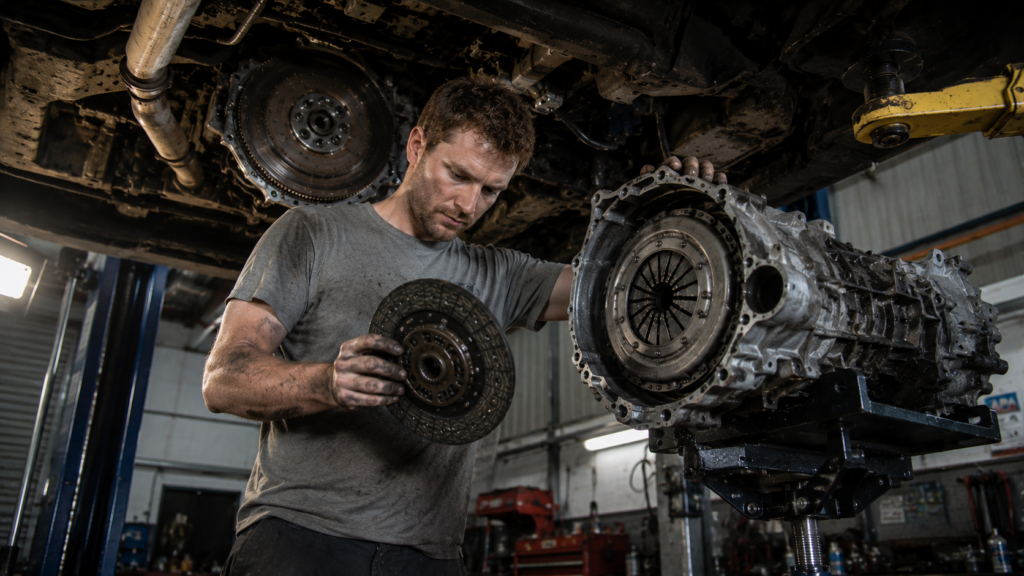
Clutch replacement cost is a number that stops people in their tracks, and there is no getting around it: this is one of the more expensive jobs on a manual car. The reason is not the parts. It is that the gearbox has to come off the engine to reach them, and that is most of the bill before anyone has picked up a clutch kit.
Clutch Replacement at a Glance
Short answer: it depends on the car, and most of the cost is labour, because the gearbox has to come off the engine. Call (02) 9533 6138 for a quote on your car.
Because the labour dominates, clutch replacement cost barely changes whether you replace one component or all of them. That is why the disc, pressure plate, release bearing and flywheel are normally done together.
The clearest sign you are facing a clutch replacement cost is engine revs rising without the car gaining speed. That is slip, and once it happens in normal driving the clutch is finished.
What Moves the Price of a Clutch Job
The price varies with the type of vehicle more than anything else.
Where your car sits comes down to a few things.
| What drives the price | Why |
|---|---|
| Front wheel drive versus rear wheel drive | Transverse front wheel drive layouts are usually tighter and take longer to separate. Some require subframe or driveshaft removal |
| Whether the flywheel needs machining or replacing | A dual mass flywheel is a significant part cost on its own and cannot always be reused |
| Whether the clutch is hydraulic | A slave cylinder inside the bellhousing has to be replaced while the box is off, because doing it later means removing the box again |
| Four wheel drive and heavy vehicles | More to disconnect, heavier components, more labour |
| Parts quality | Heavy duty kits cost more and are worth it on a towing vehicle |
Ring (02) 9533 6138 with make, model, year and kilometres, and mention whether you tow. Clutch quotes vary widely between vehicles and a number quoted without knowing the car is not worth much.
Signs Your Clutch Is Worn
AutoGuru lists these symptoms.
- Hard to select gears.
- Engine RPM rising with no increase in vehicle speed. This is clutch slip and it is the definitive one.
- A burning smell from the vehicle.
- The clutch pedal not returning.
- Unable to depress the clutch pedal.
- Shudder when changing gears.
The slip test is worth knowing. Find a safe stretch, put the car in a high gear at low speed, and accelerate firmly. A healthy clutch will make the car labour and pull. A worn one lets the revs climb while the car does not. That is the clutch failing to transmit power, and once it does that under normal driving the end is not far away.
The burning smell is worth taking seriously as well. That is friction material overheating, and it usually means the clutch has been slipping for a while.
What Should Be in the Job
AutoGuru notes that the replacement involves the clutch disc, pressure plate and flywheel, potentially a slave cylinder, and that the clutch fluid is replaced as part of the procedure.
That list matters because the labour is the expensive part and it is identical whether you replace one component or all of them. Anything skipped now is paid for twice later.
- Clutch disc. The friction plate that wears.
- Pressure plate. The spring assembly that clamps the disc. Wears alongside the disc.
- Release or throw-out bearing. Cheap part, catastrophic to have to go back in for.
- Flywheel, machined or replaced. A scored flywheel will chew a new clutch. Dual mass flywheels often cannot be machined.
- Slave cylinder, where it sits inside the bellhousing. Non-negotiable on those designs.
- Spigot or pilot bearing, where fitted.
- Gearbox oil, where it has to be drained.
- Clutch fluid replaced and the system bled.
Ask any quote whether the flywheel is being machined or replaced and whether the release bearing is included. Those two answers separate a proper job from a cheap one.
How Long Should a Clutch Last?
AutoGuru puts it this way: depending on your driving style, a clutch may last up to and over 200,000km, but it will eventually wear out and require replacement.
That range is enormous because clutch life is almost entirely about how it is used.
- Riding the clutch. Resting a foot on the pedal keeps light pressure on the release bearing and partially disengages the clutch. It is the single fastest way to wear one out.
- Holding the car on a hill with the clutch instead of the brake. Slipping deliberately, under load, generating heat.
- Slow, heavy traffic. City driving is far harder on a clutch than motorway kilometres, which is why a 120,000km commuter can need one before a 200,000km highway car.
- Towing and loads. More weight to get moving, more slip on every take-off.
- Aggressive take-offs. Self-explanatory.
The practical advice is simple. Foot off the pedal unless you are using it, handbrake or brake on hills, and take off with as little slip as the situation allows.
Is It Worth Doing on an Older Car?
Because most of the bill is labour, this is a real decision on a car with some age on it.
Two arguments in favour. A clutch is a wear item rather than a symptom of a tired car, so a car that needs one is not necessarily near the end. And because the gearbox is already out, related work that would otherwise be expensive becomes cheap: rear main seal, gearbox mounts, spigot bearing.
The argument against is when the clutch is one item on a longer list. A clutch plus a timing belt plus tyres on a car worth a few thousand is a different conversation, and worth having honestly before you commit. If a timing belt is also due, ask whether anything overlaps.
One thing worth doing while the box is out: ask about the rear main seal. It is a cheap part sitting behind the flywheel, and replacing it later means removing the gearbox again.
Clutch Replacement at Hot Tyres Riverwood
We replace clutches at 74 Belmore Rd North, Riverwood, as part of our transmission and drivetrain repairs, alongside gearbox repairs and servicing.
Before quoting we will confirm the clutch is actually the fault. Slipping, shuddering and a heavy pedal can also come from a hydraulic problem, a stretched cable or a failing engine mount, and none of those need the gearbox out. It is worth ruling them out first.
When you ring, tell us the make, model, year and kilometres, whether you tow, and what the car is doing. Slipping under load, shuddering on take-off and a pedal that will not return are three different faults.
Open Monday to Friday 8:00am to 5:00pm, Saturday 8:00am to 3:00pm. Phone (02) 9533 6138.
Symptoms That Look Like a Clutch and Are Not
Because clutch replacement cost is high, it is worth ruling out the cheaper faults that produce similar symptoms. Several of these need no gearbox removal at all.
| Symptom | Could be the clutch | Could also be |
|---|---|---|
| Pedal goes to the floor and stays there | Failed release bearing or fork | Failed clutch master or slave cylinder, or air in the hydraulics. Far cheaper |
| Shudder pulling away | Contaminated or worn clutch face | Worn engine or gearbox mounts, or an oil leak from the rear main seal onto the clutch |
| Hard to select gears | Clutch not releasing fully | Low or old gearbox oil, worn linkage or cable, or a hydraulic fault |
| Revs rise without speed | Clutch slip | On an automatic, a transmission problem instead. Confirm which you have |
| Grinding on gear change | Clutch not disengaging | Worn synchros in the gearbox, which is a different job |
| Squeal when the pedal is pressed | Release bearing | Pilot bearing, or a dry pedal pivot, which costs almost nothing |
The hydraulic ones matter most. A master or slave cylinder failure produces a pedal that feels exactly like a dead clutch, and the repair is a fraction of the price. Any workshop quoting a clutch should be checking the hydraulics first.
If the car is an automatic and the revs are rising without speed, that is a transmission symptom rather than a clutch one. Our transmission service cost guide covers what that usually means.
What Else to Do While the Gearbox Is Out
The labour is the expensive part of clutch replacement cost, and it has already been paid once the box is off. A handful of jobs that are awkward and costly on their own become inexpensive at that moment.
- Rear main seal. A cheap part sitting behind the flywheel. If it is weeping, replacing it later means removing the gearbox again. Ask about it.
- Gearbox input shaft seal. Same logic, and an early sign is oil inside the bellhousing.
- Engine and gearbox mounts. Easier to access and a common cause of the shudder people blame on the clutch.
- Spigot or pilot bearing. Inexpensive, and a failure means going back in.
- Gearbox oil. If it has to be drained anyway, refill with fresh rather than the same oil.
- Clutch hydraulics. Fluid replaced and the system properly bled, with the slave cylinder replaced if it lives inside the bellhousing.
- Starter motor inspection. The starter is right there and its condition is easy to assess with access.
None of these are upsells if they are genuinely worn. They are the difference between one gearbox removal and two. Ask your workshop which of them they inspect as standard and which they would recommend on your car.
Frequently Asked Questions
What affects the price of a clutch replacement?
It depends on the vehicle. Most of the cost is labour, because the gearbox has to come off the engine. Call (02) 9533 6138 for a quote on your car.
How do I know if my clutch is worn?
The clearest sign is engine revs rising without the car speeding up, which is clutch slip. Others include difficulty selecting gears, shudder on take-off, a burning smell, and a pedal that will not return.
How long does a clutch last?
AutoGuru says a clutch may last up to and over 200,000km depending on driving style. City traffic, towing, riding the pedal and holding the car on hills all shorten it considerably.
What is included in a clutch replacement?
Typically the clutch disc, pressure plate and release bearing, with the flywheel machined or replaced, plus the slave cylinder where it sits inside the bellhousing, and the clutch fluid replaced.
Does the flywheel need replacing too?
It needs to be machined or replaced if it is scored or worn, because a damaged surface will destroy a new clutch. Dual mass flywheels often cannot be machined and are a significant part cost.
Can I drive with a slipping clutch?
For a short time, carefully. Slip generates heat, heat accelerates wear, and a clutch that slips badly can leave you unable to drive at all. Get it looked at rather than waiting.
Is a shudder always the clutch?
No. Shudder on take-off can also come from worn engine or gearbox mounts, or contamination on the clutch face from an oil leak. It is worth diagnosing before committing to the job.
Is my clutch or my hydraulics the problem?
A pedal that goes to the floor and stays there is more often a failed master or slave cylinder than a worn clutch, and it is far cheaper to fix. Any quote should check the hydraulics before condemning the clutch.
Why does my car shudder when pulling away?
It can be the clutch, but worn engine or gearbox mounts and an oil leak onto the clutch face produce the same feel. It is worth diagnosing before committing to the job.
What else should be replaced while the gearbox is off?
The rear main seal if it is weeping, the spigot bearing, engine and gearbox mounts if worn, and the slave cylinder where it sits inside the bellhousing. Doing them later means removing the gearbox again.
Can a clutch be adjusted instead of replaced?
On older cable operated clutches, sometimes. Most modern hydraulic clutches are self-adjusting, so a slipping clutch on those is a wear problem rather than an adjustment one.
Does towing shorten clutch life?
Considerably. Every take-off under load means more slip and more heat, which is the mechanism by which a clutch wears out.