
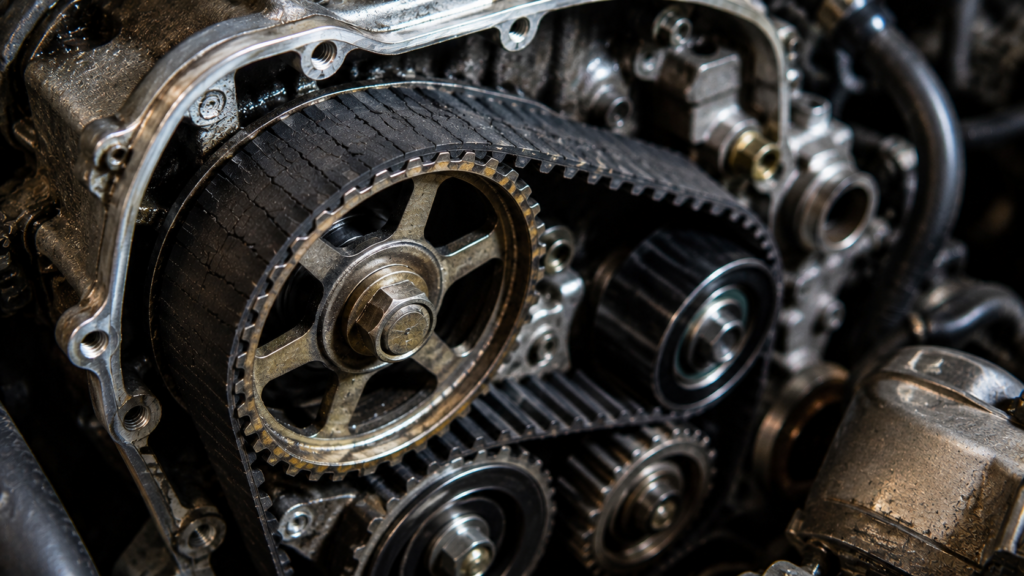
Timing belt replacement cost is the figure people go looking for right after a mechanic mentions it at a service, usually followed by the thought that it sounds steep for a rubber belt. It is steep. It is also the cheapest thing you will ever do compared with what happens when the belt lets go. This guide covers what drives the price, when the job is genuinely due, and how to work out whether your car even has a belt.
Timing Belt Replacement Cost at a Glance
Short answer: timing belt replacement cost in Australia starts around $550 and can rise past $1,300, according to AutoGuru. Where your car falls depends on how buried the belt is and what else comes out with it.
The timing belt replacement cost you are quoted should include the tensioner and idler pulleys, and the water pump where the pump is belt driven. A quote covering the belt alone looks cheaper and is not.
Set against a snapped belt on an interference engine, which usually means bent valves and a damaged head, the timing belt replacement cost is the smallest number in the whole conversation.
What Timing Belt Replacement Cost Looks Like in Australia
According to AutoGuru, the average timing belt replacement cost starts around the $550 mark and can rise to over $1,300.
That is a wide spread and it is not padding. Four things move a quote from one end of it to the other.
| What drives the price | Why it matters |
|---|---|
| How buried the belt is | On some engines the belt sits behind a cover and a few brackets. On others the engine mount comes out. On transverse V6 layouts the labour can triple |
| What gets replaced with it | A belt on its own is false economy. The tensioner and idler pulleys wear on the same clock and are normally done together |
| Whether the water pump is belt driven | If it is, replacing it while everything is apart costs little more than the part. Skip it and a later failure means paying the whole labour bill twice |
| Parts quality | Genuine kits cost more than aftermarket. On an engine where a failure destroys the motor, this is not where to save fifty dollars |
AutoGuru notes the job involves replacing the belt, tensioner and idler pulleys, and that the water pump is inspected and replaced if worn, which may add to the cost.
For a figure on your car, ring (02) 9533 6138 with your make, model, year and kilometres. A timing belt quote given without knowing the engine is a guess, because the labour hours vary by a factor of three across common vehicles.
When Is a Timing Belt Actually Due?
AutoGuru puts the general guidance at every five years or 100,000 kilometres. Your manufacturer has a specific figure and that is the one that counts. Some engines specify 90,000km, others 150,000km or more.
Two things catch people out.
- It is whichever comes first. A car that has covered 40,000km in nine years is due on age, not distance. Rubber degrades sitting still, which is why low kilometre older cars are the ones that get missed.
- The clock runs from the last change, not from new. If you bought the car used and there is no record of a belt change, assume it has not been done. That assumption costs you a belt. The opposite assumption can cost you an engine.
The Detail That Decides Everything
One fact determines whether a snapped belt is an inconvenience or the end of the engine.
In an interference engine, the valves and pistons occupy the same space at different moments and the belt is what keeps them apart. If it breaks while running, the camshaft stops, the crankshaft keeps turning, and pistons meet open valves. Bent valves, damaged pistons, often a damaged head. The repair is frequently worth more than the car.
In a non-interference engine there is clearance. The belt breaks, the engine stops, you get towed and fitted with a new belt. Expensive day, not a catastrophe.
Most modern engines are interference designs, because the tight clearances that cause the problem are the same ones that make an engine efficient. AutoGuru puts it plainly: if the belt is not replaced as recommended it can slip, stretch or break, causing major engine damage and leaving you stranded with a large bill.
If you do not know which type you have, that is the first question to ask, because it changes how urgent the interval is.
Does Your Car Even Have a Timing Belt?
Plenty of people book a timing belt replacement for a car that does not have one. Engines use either a rubber belt or a metal chain, and the two are maintained completely differently.
| Timing belt | Timing chain | |
|---|---|---|
| Material | Reinforced rubber | Metal chain, running in engine oil |
| Location | Behind a cover on the outside of the engine | Inside the engine |
| Service life | Replaced on a set interval | Often designed to last the life of the engine |
| Warning before failure | Very little. It is scheduled, not wait and see | Usually rattles, worst on cold start |
| Cost when it needs doing | Lower | Higher, the engine has to be opened up |
A rough guide: many four cylinder Japanese and Korean engines from the 1990s and 2000s use belts, while a lot of newer designs moved to chains. There are exceptions both ways, and the only reliable answer comes from the specification for your exact engine rather than the model name. We cover the other side of it in our guide to timing chain replacement cost.
Warning Signs, and Why Not to Rely on Them
Timing belts do not give much notice. That is the whole reason there is an interval. Still, these are worth acting on straight away:
- A ticking or slapping noise from the front of the engine that changes with engine speed.
- Oil weeping near the timing cover. Oil destroys rubber. A leaking cam or crank seal will take the belt with it.
- Rough running or misfires that appeared suddenly, which can mean the belt has jumped a tooth.
- The engine cranks but will not start, with no compression. Often this means the belt has already gone.
- Visible cracking, glazing or missing teeth if you can see the belt.
The honest position is that a belt can look fine right up until it fails. Inspection catches oil contamination and obvious damage. It is not a substitute for replacing on schedule.
What Should Be in the Quote
Quotes vary because workshops include different things. Comparing two numbers without comparing what sits behind them is how people accidentally pick the more expensive option.
- The belt itself.
- Tensioner and idler pulleys. These wear on the same schedule. Reusing old pulleys with a new belt is the most common corner cut and the most common cause of a repeat failure.
- Water pump, where it is belt driven. It sits behind the same covers. Doing it now costs the part. Doing it in two years costs the part plus the whole labour bill again.
- Cam and crank seals if they show any weeping. Same logic.
- Drive belt, if it has to come off anyway.
- Coolant, where the water pump is replaced.
Ask any workshop quoting you two questions: does this include the tensioner and pulleys, and is the water pump belt driven on this engine? The answers tell you a lot about the quote.
The Arithmetic of Skipping It
| Decision | Typical outcome |
|---|---|
| Replace on schedule | $550 to $1,300, booked in advance, usually back the same day |
| Defer on an interference engine and the belt breaks | Bent valves, often piston and head damage. Rebuild or replacement, plus towing |
| Defer on a non-interference engine and the belt breaks | Towing, then the belt job you were going to do anyway, at a worse time |
| Replace the belt but reuse old pulleys | Risk of the same failure well inside the interval, and paying the labour twice |
The uncomfortable part is that a belt does not fail politely in a driveway. It fails under load, which means on a motorway or pulling away from lights.
Timing Belt Replacement at Hot Tyres Riverwood
We handle timing belt and timing chain work at 74 Belmore Rd North, Riverwood, alongside the rest of our mechanical repairs.
When you call, have your make, model, year and current kilometres ready. We will tell you whether your engine uses a belt or a chain, what the manufacturer interval is, whether the water pump is belt driven, and what the job comes to on your car with the tensioner and pulleys included.
If you have just bought a used car with no service history, sort this early. It is the one deferred maintenance item that can turn a good buy into a write-off. We go through it in detail in our guide to timing belts on used cars.
Open Monday to Friday 8:00am to 5:00pm and Saturday 8:00am to 3:00pm. Phone (02) 9533 6138.
Why Two Quotes Can Differ by $700
The timing belt replacement cost range is wide enough that people assume someone is overcharging. Usually nobody is. The same job on two different engines is genuinely two different jobs.
| Engine layout | What has to happen | Effect on labour |
|---|---|---|
| Longitudinal four cylinder, belt at the front | Covers off, belt off, belt on | Lowest. Straightforward access |
| Transverse four cylinder | Engine mount usually has to be supported and removed to get the cover off | Middle |
| Transverse V6 | Access to the rear bank can mean removing or rocking the engine | Highest on many common cars |
| Diesel with a belt driven pump | Injection timing may need setting after the belt is fitted | Higher, and specialist |
| Belt driven water pump | Coolant drained, pump replaced, system refilled and bled | Adds parts and time, saves far more later |
Two quotes on the same car should be close. Two quotes on different cars can differ by more than the price of the parts. When you are comparing, compare what is included rather than the headline figure.
The other reason for a gap is scope. A quote covering the belt alone will always beat a quote covering the belt, tensioner, idlers and water pump. It is also the quote that brings you back sooner.
After the Job: What to Expect and What to Check
A timing belt replacement should be uneventful afterwards. A few things are worth knowing so you can tell normal from not.
- Keep the invoice and note the odometer. This is the record that matters at resale, and it is the one that most cars are missing. Photograph it.
- Ask for a sticker under the bonnet with the date and kilometres. It is standard practice and it saves the next person guessing.
- Expect the engine to sound the same. A new belt does not change how a healthy engine runs. If anything sounds different, say so straight away.
- Watch for coolant loss over the first week if the water pump was replaced. A small drop as air works out of the system is normal. A visible leak is not.
- Check for any new warning lights. Sensors get disturbed during the job and a loose connector is easy to fix immediately and annoying to chase later.
And set a reminder for the next interval based on the date and kilometres on that invoice, not on when you bought the car. Five years is easy to lose track of, and the whole point of the interval is that the belt gives no warning of its own.
Frequently Asked Questions
How much does timing belt replacement cost in Australia?
AutoGuru puts the average at around $550, rising to over $1,300 depending on the vehicle. The spread comes down to how accessible the belt is, whether the water pump is belt driven, and whether the tensioner and pulleys are included.
How often should a timing belt be replaced?
General guidance is every five years or 100,000 kilometres, whichever comes first, but your manufacturer figure is the one that counts. Some engines specify 90,000km, others 150,000km or more.
What happens if a timing belt breaks?
On an interference engine, pistons hit open valves and the engine is usually badly damaged. On a non-interference engine the car simply stops and needs a tow and a new belt.
Can I just replace the belt and not the pulleys?
You can, but it is the most common cause of a repeat failure. The tensioner and idler pulleys wear on the same schedule as the belt and are normally replaced together.
Should the water pump be done at the same time?
If the water pump is driven by the timing belt, yes. It sits behind the same covers, so doing it now costs little more than the part, while doing it later means paying the full labour again.
Does my car have a timing belt or a timing chain?
It depends on the exact engine, not the model name. Many four cylinder Japanese and Korean engines from the 1990s and 2000s use belts and many newer designs use chains, with exceptions both ways. Call with your details and we will confirm.
Are there warning signs before a timing belt fails?
Rarely useful ones. A ticking noise, oil near the timing cover, sudden rough running or a no-start with no compression are all worth immediate attention, but a belt can look fine until the moment it breaks.
Why do timing belt quotes vary so much?
Because the labour varies enormously by engine. A belt at the front of a longitudinal four cylinder is straightforward, while a transverse V6 can require the engine to be moved. Scope matters too, since a quote for the belt alone will always look cheaper than one including the tensioner, pulleys and water pump.
Do I need to replace the water pump with the timing belt?
If the water pump is driven by the timing belt, it is worth doing. It sits behind the same covers, so replacing it now costs little more than the part, while a later failure means paying the full labour again.
How long does a timing belt replacement take?
It depends entirely on the engine. Straightforward layouts can be done in a few hours, while engines needing mount removal or engine movement take considerably longer.
What should I keep after the job?
The invoice showing the date and odometer reading, and ideally a sticker under the bonnet. It is the record that proves the belt was done, and most used cars are missing it.
Can I go past the timing belt interval if the car is low kilometres?
Not safely. The interval is whichever comes first, and rubber degrades with age whether the car is driven or not. A low kilometre older car is exactly the profile that gets caught out.