
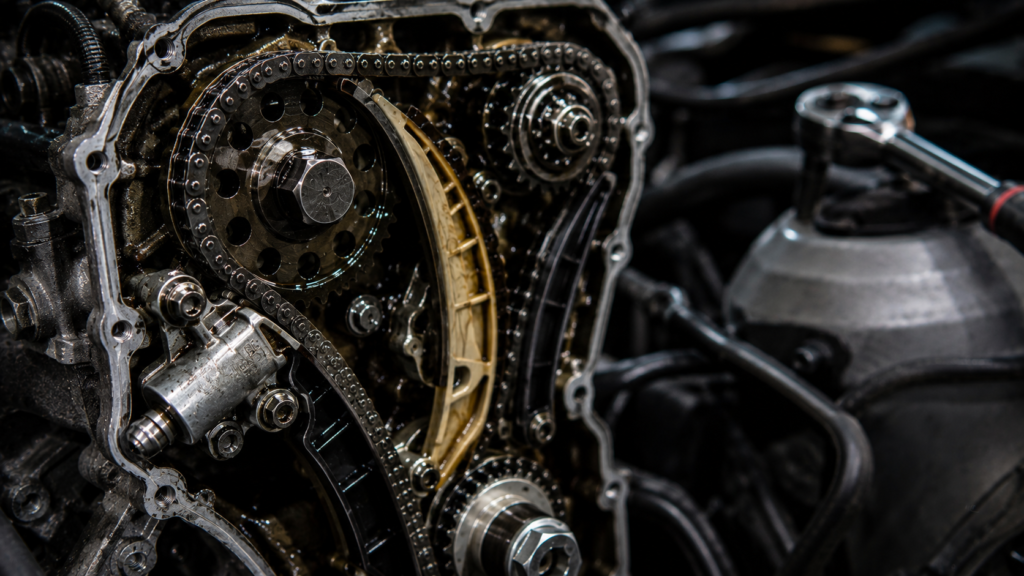
Timing chain replacement cost is the number people go looking for after hearing a rattle on cold start, and it is a bigger number than most expect. Chains were meant to be the maintenance free option. Fit and forget, no interval, lasts the life of the engine. That is mostly true, and when it is not true it costs considerably more than a belt would have.
Timing Chain Replacement Cost at a Glance
Short answer: timing chain replacement cost averages $1,200 to $2,000 or more in Australia, according to AutoGuru. That is roughly double a belt, because the chain runs inside the engine rather than behind a cover.
There is no service interval, so timing chain replacement cost only arrives when the chain gives you symptoms. The usual first sign is a rattle from the front of the engine on a cold start.
What pushes timing chain replacement cost up is how much of the engine has to come apart, and whether the guides, tensioner and sprockets are included. They should be.
What Timing Chain Replacement Cost Runs To
According to AutoGuru, the average timing chain replacement cost is $1,200 to $2,000 or more depending on the car you drive.
That is roughly double a timing belt, and the reason is access. A belt sits behind a plastic cover on the outside of the engine. A chain runs inside the engine in oil, so the front of the engine has to come apart to reach it. On some layouts the engine has to come out entirely.
| Timing belt | Timing chain | |
|---|---|---|
| Typical cost | $550 to $1,300+ | $1,200 to $2,000+ |
| Location | Outside the engine behind a cover | Inside the engine, running in oil |
| Maintenance | Replaced on a set interval | No interval. Replaced when it fails |
| Warning | Very little | Usually rattles, worst on cold start |
| What else gets done | Tensioner, idlers, often the water pump | Guides, tensioner, sprockets, gaskets and seals |
For a figure on your car, ring (02) 9533 6138 with the make, model, year and kilometres. Chain jobs vary more than belt jobs because the amount of engine that has to come apart differs enormously between designs.
How to Tell a Chain Is Worn
Unlike a belt, a chain usually warns you. AutoGuru lists these signs:
- A rattling noise from the front of the engine. Loudest on a cold start, often quietening once oil pressure builds. This is the classic one.
- Check engine light with timing related codes. The engine management can see that cam and crank position no longer line up.
- Rough running.
- Excessive fuel consumption.
- Poor power or hesitation when driving.
- Stalling or stumbling at idle.
The cold start rattle is the one worth acting on early. A chain that rattles for a second or two on start-up is telling you the tensioner is not holding pressure, and that is a much cheaper conversation than the one after the chain jumps a tooth.
Why Chains Wear When They Are Not Meant To
AutoGuru identifies three things behind chain failure: the chain stretches over time, the tensioner or guides fail, or inadequate lubrication damages the chain.
That third one is the important one, because it is the one you control.
A timing chain runs in engine oil and depends entirely on it. Oil that is old, low, or the wrong grade means the tensioner cannot hold pressure and the plastic guides wear through. On engines with a known appetite for oil, a chain problem is frequently an oil maintenance problem that arrived two years later.
The practical version: on a chain engine, servicing on time with the correct oil is timing chain maintenance. There is no interval to book, so the servicing is the interval. Our guide to oil services and change intervals covers what your engine actually needs.
What “Chain Stretch” Actually Means
The chain does not stretch like elastic. The pins and rollers in each link wear, and thousands of tiny wear points add up to a chain that is measurably longer than it was.
That extra length has to go somewhere. The tensioner takes it up until it runs out of travel, and then the chain starts slapping against the guides. The guides are plastic. They wear through, then fragments end up in the sump, and the chain gets looser still.
Eventually the chain jumps a tooth on a sprocket. At that point cam timing is wrong, and on most modern engines the result is the same as a snapped belt: pistons meeting valves.
What a Chain Job Should Include
Replacing the chain alone is not the job. The parts that wear alongside it have to go too, or you are paying the labour twice.
- The chain or chains. Some engines have more than one.
- Tensioner. Frequently the actual cause rather than the chain.
- Guides and rails. Plastic parts that wear as a matter of course.
- Sprockets, where worn. A worn sprocket will chew a new chain.
- Front cover gaskets and seals. They come off to do the job and should not be reused.
- An oil and filter change afterwards. Debris from worn guides ends up in the sump.
Ask any quote whether the guides and tensioner are included. If the answer is only the chain, that is not a repair, it is a deferral.
Is It Worth Doing?
At $1,200 to $2,000 and up, this is a genuine decision on an older car rather than an automatic yes.
- What is the car worth? If the repair is more than half the value, the arithmetic gets hard.
- What else is due? A chain job on a car that also needs a clutch and four tyres is a different conversation.
- How is the rest of the engine? A chain worn from poor lubrication often sits in an engine that has other wear from the same cause.
- Is it rattling or has it already jumped? A rattle caught early is a repair. A chain that has jumped and bent valves is usually the end.
The one thing not worth doing is driving on a rattling chain to see how long it lasts. The failure is sudden and it takes the engine with it.
Timing Chain Work at Hot Tyres Riverwood
We diagnose and replace timing chains at 74 Belmore Rd North, Riverwood, as part of our mechanical repairs and engine diagnostics.
If your car is rattling on cold start, bring it in before it gets worse. We will confirm whether the noise is the chain, the tensioner, or something else entirely, read any timing related fault codes, and tell you what the job costs on your engine with the guides and tensioner included.
If it turns out your engine uses a belt rather than a chain, our timing belt replacement cost guide covers that side. Buying a used car and trying to work out which you are dealing with? See what to check before you buy.
Open Monday to Friday 8:00am to 5:00pm, Saturday 8:00am to 3:00pm. Phone (02) 9533 6138.
Decoding the Rattle: How Long Have You Got?
Not every engine noise is a chain, and not every chain rattle is urgent. What separates them is when the noise happens and how long it lasts.
| What you hear | What it usually means | Urgency |
|---|---|---|
| One or two seconds of rattle on a cold start, then silence | Tensioner not holding pressure overnight. The chain is slack until oil pressure builds | Book it in. This is the early stage and the cheapest one |
| Rattle on cold start that takes longer to clear each month | Progressive wear on chain and guides | Do not leave it. This is the stage before it jumps |
| Rattle present at idle when warm | Chain and guides significantly worn | Urgent |
| Rattle that rises and falls with engine speed at all temperatures | Advanced wear, or a different component entirely | Stop driving it and get it diagnosed |
| Ticking rather than rattling, steady with revs | More often valve train or an injector than the chain | Diagnose before assuming a chain job |
The distinction that matters is cold start versus always. A chain that only rattles cold is telling you the tensioner cannot hold oil pressure overnight. That is the moment to act, because everything downstream of it costs more.
If the noise is accompanied by a check engine light, get the codes read. Timing related codes such as camshaft and crankshaft correlation faults are the engine management telling you the same thing the noise is.
How to Make a Chain Last the Life of the Engine
Chains are meant to be lifetime components and on a well maintained engine they usually are. Three habits decide it.
- Service on time with the correct oil grade. The chain, tensioner and guides all depend on oil pressure and film strength. Extended intervals on cheap oil is the single most common cause of premature chain wear.
- Check the oil level between services. Engines that use oil are common, and a chain running on a low sump is a chain running on intermittent pressure. Our oil service guide covers intervals and what your engine needs.
- Let it warm before working it hard. The first minute after a cold start is when the chain is at its slackest and the oil at its thickest. Gentle until temperature is up.
There is also a case for shortening the service interval if the car does mostly short trips. Oil that never reaches full operating temperature does not shed moisture and fuel dilution, and degraded oil is what wears chains.
None of this is exotic maintenance. It is ordinary servicing done properly, which on a chain engine is the only timing maintenance there is.
Frequently Asked Questions
How much is timing chain replacement in Australia?
AutoGuru puts the average at $1,200 to $2,000 or more depending on the vehicle. It costs more than a belt because the chain runs inside the engine and the front of the engine has to come apart to reach it.
Do timing chains need to be replaced?
There is no set interval. A chain may last the life of the engine. It is replaced when it shows symptoms, most commonly a rattle on cold start.
What does a worn timing chain sound like?
A rattling or chattering noise from the front of the engine, loudest in the first seconds after a cold start and often quieter once oil pressure builds.
Can I keep driving with a rattling timing chain?
It is not worth the risk. When a worn chain jumps a tooth the cam timing goes out and on most modern engines pistons meet valves, which usually ends the engine.
What causes a timing chain to wear out?
Chain stretch over time, failure of the tensioner or guides, and inadequate lubrication. The last one is the most preventable, which is why on-time servicing with the correct oil matters on chain engines.
Should the tensioner and guides be replaced too?
Yes. They wear alongside the chain and are frequently the actual cause. Replacing the chain alone means paying the labour again later.
Is a timing chain better than a timing belt?
Neither is better outright. A chain usually avoids a scheduled replacement and gives warning before it fails. A belt costs less to replace but must be done on time. A chain that does fail costs roughly double.
Is a rattling timing chain always expensive to fix?
Not always. Sometimes the tensioner has failed while the chain is still serviceable, which is a smaller job. That is why diagnosis before quoting matters, and why acting on a cold start rattle early is worth doing.
Can I just top up the oil instead of replacing the chain?
No. Correct oil level and grade will stop a chain wearing further, but it does not restore a chain that has already stretched or guides that have already worn through.
How long can I drive with a timing chain rattle?
There is no safe number. A worn chain fails when it jumps a tooth, and that is sudden. On most modern engines it takes the valves with it.
Does a timing chain need replacing at a certain kilometre figure?
No. Unlike a belt there is no scheduled interval. It is replaced on symptoms, which is why the noise matters so much.
Why did my timing chain wear out early?
Usually lubrication. Extended service intervals, the wrong oil grade, running low on oil, or an engine that consumes oil between services will all shorten chain life considerably.