
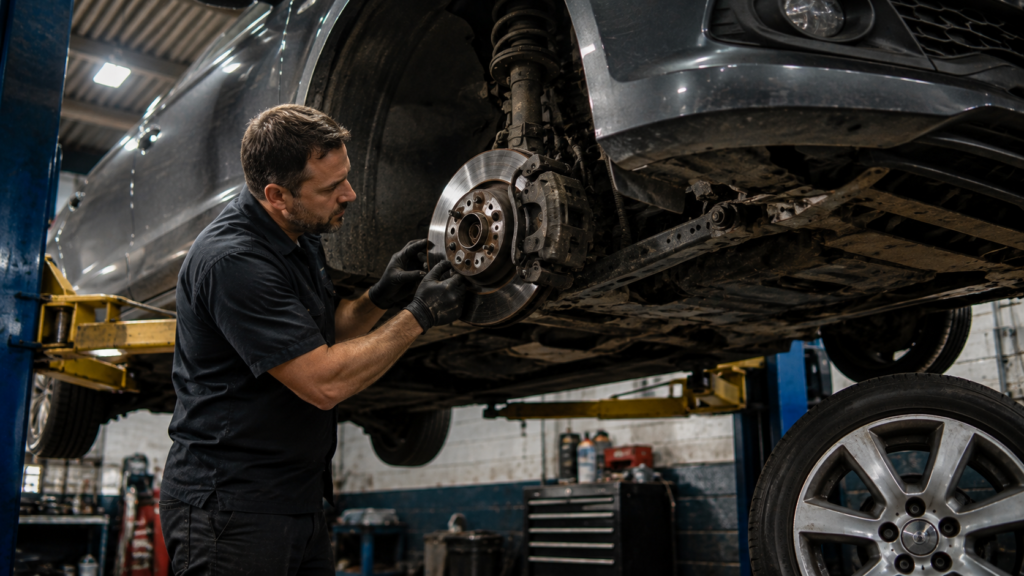
Wheel bearing replacement cost is one of the more reasonable numbers in car repair, which is worth knowing because a failing bearing is one of the less reasonable things to ignore. It starts as a hum you can talk yourself out of hearing. Left long enough it becomes a wheel with enough play to affect steering and braking, or one that seizes.
Wheel Bearing Replacement Cost at a Glance
Short answer: wheel bearing replacement cost runs $290 to $475 or more per bearing in Australia, on AutoGuru figures. It varies with where the bearing sits and whether it has to be pressed in and out of the hub.
Bearings are done one at a time, so wheel bearing replacement cost applies to the corner that has failed rather than both sides. There is no pairing rule the way there is with brake pads.
It is one of the more affordable repairs on this list, which is worth knowing, because a failing bearing is one of the least sensible things to keep driving on.
What Wheel Bearing Replacement Cost Runs To
According to AutoGuru, a wheel bearing replacement can cost $290 to $475 or more, depending on the location of the bearing and whether it requires pressing in and out of the hub assembly.
That pressing point is the main variable. Bearings come in two broad arrangements.
| Type | What is involved | Effect on cost |
|---|---|---|
| Hub assembly, bolt-on | The bearing comes as a sealed unit with the hub. Old one off, new one on | Lower labour, higher part cost |
| Pressed bearing | Pressed out of the hub or knuckle and a new one pressed in, usually with the assembly off the car | Higher labour, lower part cost |
| Rear bearing on a driven axle | More to disassemble, sometimes driveshaft and brake components | Higher again |
Bearings are replaced one at a time, on the side that has failed. There is no requirement to do them in pairs the way there is with brake pads. Ring (02) 9533 6138 with your make, model, year and which corner the noise is coming from.
How to Tell a Wheel Bearing Is Failing
AutoGuru lists three signs, and they are the three that matter.
- A rumbling noise that increases with road speed. The giveaway. Louder the faster you go, unchanged by gear or braking.
- Vibration through the steering wheel while driving.
- A knocking noise going over bumps.
Two tests you can do on the road. First, the hum from a failing bearing often changes when you swing the wheel gently left and right at speed, because you are loading and unloading the bearing. Louder turning one way and quieter the other usually means the bearing on the outside of the turn. Second, a bearing hum tracks road speed. So does tyre noise, but a driveline noise follows engine speed instead, which is how you separate them.
A worn bearing can also lift fuel consumption, because the engine works harder to keep the car moving.
Why You Should Not Leave It
AutoGuru is direct: continuing to drive with bad wheel bearings can pose a safety issue, because of excessive free play appearing at the wheel, or the bearing seizing and causing the wheel to lock up.
Those are two different failures and both are serious. Free play means the wheel is no longer held square to the car, which affects steering, tyre wear and braking stability. A seizure at speed is exactly what it sounds like.
There is a quieter cost too. A bearing with play lets the wheel move under load, which puts uneven wear into the tyre and throws out your alignment. People arrive with a tyre worn on one edge and an alignment that will not hold, and the bearing is why both keep coming back. Our wheel alignment guide explains why a worn bearing has to be sorted before an alignment is worth paying for.
What Makes Bearings Fail Early
- Potholes and kerb strikes. A single hard hit can damage a bearing that then takes months to become audible.
- Water and contamination. Deep water, pressure washing straight at the hub, or a failed seal lets water in and corrosion does the rest.
- Incorrect fitting. A pressed bearing installed with the load through the wrong race is damaged before the car leaves the workshop.
- Hub nut torque. Over-tightened or under-tightened, both kill bearings. Specification matters here more than on most fasteners.
- Bigger wheels and low profile tyres. Less sidewall means more shock loading straight into the bearing.
- Towing and heavy loads. Sustained load, particularly on rear bearings.
Bearing, Tyre or Something Else?
A hum at speed has several possible causes that cost very different amounts to fix. Rule out the cheap ones first.
| What you notice | Likely cause |
|---|---|
| Hum rises with road speed, changes when you swing the wheel left and right | Wheel bearing |
| Hum rises with road speed, unchanged by steering, tyres worn unevenly | Tyre noise from cupping or feathering |
| Noise follows engine speed rather than road speed | Driveline or engine, not a bearing |
| Clicking on sharp turns rather than a hum | CV joint |
| Knocking over bumps but no hum | Suspension bushes, links or ball joints |
| Grinding that changes when you brake | Brakes |
Worth having it checked rather than guessing, because a tyre rotation is cheap and a bearing is not. If it turns out to be the tyres, our guide to common tyre noises and their causes explains what each pattern sounds like. If it is a clicking rather than a hum, see our CV joint replacement cost guide.
What a Workshop Actually Checks
Diagnosing a bearing properly takes the wheel off the ground, and there is a sequence to it.
- Rock the wheel top and bottom with the car on a hoist. Play here points at the bearing or a ball joint, and the two are separated by where you feel the movement.
- Spin the wheel by hand and listen. A failed bearing is often audible as roughness or grinding.
- Check for heat after a drive. A bearing that is failing runs hot compared with the other side.
- Check the seal and the ABS sensor. Many bearings carry the ABS ring, and a failing bearing can trigger ABS faults before it becomes noisy.
- Inspect the tyre wear pattern on that corner, because a bearing with play leaves a signature.
That ABS point is worth knowing. If you have an ABS or traction control light on and a hum from one corner, they are frequently the same fault rather than two.
Wheel Bearing Replacement at Hot Tyres Riverwood
We diagnose and replace wheel bearings at 74 Belmore Rd North, Riverwood, as part of our steering and suspension repairs. Because we do tyres and alignment in the same workshop, we can tell you whether the noise is the bearing or the tyres without sending you somewhere else to find out.
Bring the car in with a description of what you hear and when. Which corner, whether it changes with steering, whether it started after a pothole. That narrows it quickly.
Open Monday to Friday 8:00am to 5:00pm, Saturday 8:00am to 3:00pm. Phone (02) 9533 6138.
The Road Test That Finds the Corner
Before anyone puts the car on a hoist, a short drive will usually tell you which wheel is at fault. It is worth doing on a quiet road at a steady 60 to 80km/h.
- Find the speed where the hum is clearest and hold it. A bearing hum is constant and tied to road speed, not engine speed. Slip into neutral briefly: if the noise is unchanged, it is not the driveline.
- Sweep gently left, then gently right. Not a lane change, a long slow arc. Loading the car to one side puts weight on the opposite bearing.
- Note which direction makes it louder. Louder in a right hand sweep usually means the left front bearing, because the load has moved to the left wheel. Louder turning left points at the right.
- Check whether it changes when braking. If it does, brakes are in the mix rather than a bearing.
- Listen for a change in pitch over bumps. A knock or clunk on top of the hum suggests play has developed.
This is not a substitute for a proper inspection, but arriving able to say “hum from about 60, louder when I sweep right, no change under braking” saves diagnostic time and points straight at the corner.
Front Bearings and Rear Bearings Are Not the Same Job
Where the bearing sits changes both the symptoms and the wheel bearing replacement cost.
| Front bearing | Rear bearing | |
|---|---|---|
| Typical symptom | Hum plus steering vibration | Hum, often with a knock over bumps, no steering feel |
| What it carries | Steering, braking and drive loads on most cars | Mostly weight, plus drive on rear wheel drive |
| Access | Behind the hub and brake assembly, often with the driveshaft through it | Usually simpler on a non-driven axle, more involved on a driven one |
| Effect on alignment | Directly affects camber and toe, so alignment will not hold | Affects rear geometry, which shows as uneven rear tyre wear |
| Usual cost position | Middle to higher end of the range | Lower end on a non-driven axle, higher on a driven one |
The alignment point is the one that catches people out. A worn front bearing lets the wheel move under load, so a wheel alignment done before the bearing is replaced will not hold. If you have paid for an alignment that did not last, this is a common reason. Our guide to alignment intervals covers when it is worth doing.
The tyre wear pattern is a useful confirmation. A bearing with play tends to leave scalloped or feathered wear on one edge of one tyre, on one corner only. Wear on both sides of an axle is more likely alignment or pressures.
Frequently Asked Questions
How much does wheel bearing replacement cost in Australia?
AutoGuru puts it at $290 to $475 or more per bearing, depending on where the bearing sits and whether it has to be pressed in and out of the hub assembly.
What does a bad wheel bearing sound like?
A rumbling or humming noise that gets louder with road speed. It often changes when you steer gently left and right at speed, because that loads and unloads the bearing.
Can I drive with a bad wheel bearing?
Not for long. AutoGuru warns that a failing bearing can develop excessive free play at the wheel or seize and cause the wheel to lock up. Get it checked promptly.
Do wheel bearings need to be replaced in pairs?
No. Unlike brake pads, bearings are replaced on the side that has failed. There is no requirement to do both.
How long does a wheel bearing last?
There is no set interval. Most last many years, but potholes, kerb strikes, water ingress and incorrect fitting can all cut that short.
Can a wheel bearing cause an ABS light?
Yes. Many bearings carry the ABS sensor ring, so a failing bearing can trigger ABS or traction control faults, sometimes before it becomes audible.
Is the humming my tyres or my wheel bearing?
Both rise with road speed, which is why they get confused. A bearing hum usually changes when you steer left and right at speed, while tyre noise does not. Uneven tyre wear points to the tyres.
Which wheel bearing is failing?
On a road test, sweep gently left and right at a steady speed. The bearing on the outside of the turn is loaded, so a hum that gets louder in a right hand sweep usually points at the left wheel.
Can a wheel bearing cause uneven tyre wear?
Yes. Play in the bearing lets the wheel move under load, which leaves scalloped or feathered wear on one edge of one tyre and stops an alignment holding.
Will a wheel alignment fix a humming noise?
No. If the noise is a bearing, an alignment will not change it, and the alignment itself will not hold until the bearing is replaced.
How long can I keep driving on a noisy wheel bearing?
Treat it as weeks rather than months, and get it inspected promptly. A bearing that develops significant play or seizes is a genuine safety problem.
Is a rear wheel bearing cheaper than a front one?
Often, on a non-driven rear axle, because there is less to disassemble. On a driven rear axle the difference narrows.