
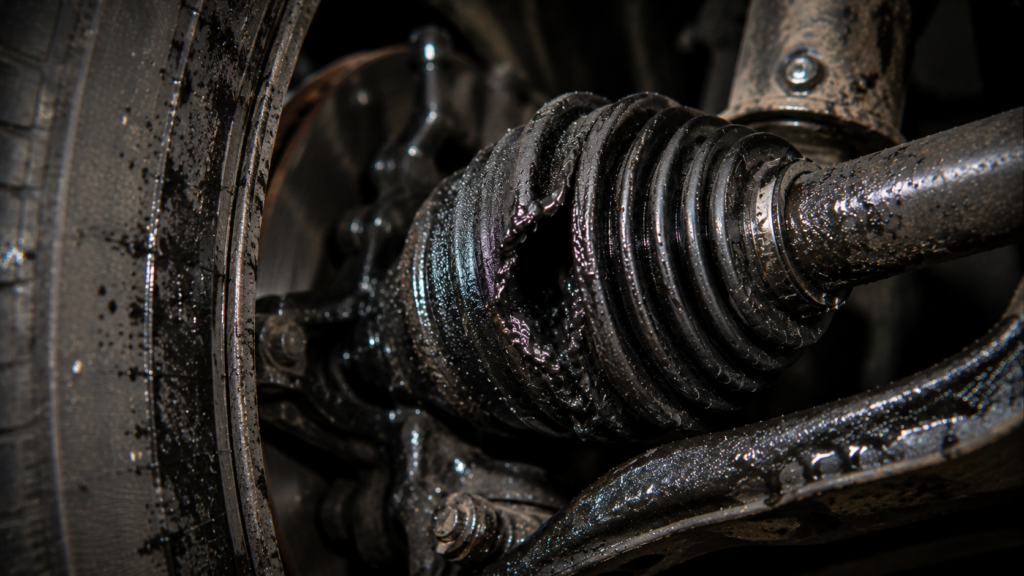
CV joint replacement cost is the question that follows a clicking noise on tight corners, usually in a car park, usually loud enough that the person in the passenger seat asks what that was. The good news is that the noise is unambiguous. The better news is that if you catch the cause early enough, you may not need the joint at all.
CV Joint Replacement Cost at a Glance
Short answer: AutoGuru says to expect to pay in the hundreds for a CV joint replacement. The CV joint replacement cost you end up with depends almost entirely on how long the boot has been split.
Catch a split boot early and you may pay for a boot and fresh grease rather than a joint. Leave it and the CV joint replacement cost climbs to a joint, or a complete driveshaft.
That is the whole message of this article. CV joint replacement cost is not really about the joint. It is about how quickly you noticed the grease.
What CV Joint Replacement Cost Runs To
AutoGuru does not publish a single figure for this one, and says to expect to be paying in the hundreds for a CV joint replacement.
The spread comes from what actually gets replaced, which is where it pays to understand the parts.
| What is replaced | When | Relative cost |
|---|---|---|
| CV boot only | The boot has split but the joint is still good and has not run dry | Lowest |
| Outer CV joint | The joint itself is worn, usually after a boot has been split for a while | Middle |
| Complete driveshaft | Often cheaper than rebuilding, particularly where both joints are worn or the shaft is damaged | Highest, but sometimes the sensible choice |
The single biggest factor in what you pay is how long the boot has been split. Ring (02) 9533 6138 with your make, model and year, and whether you have noticed grease anywhere.
Signs of a Failing CV Joint
AutoGuru lists these warning signs.
- Clicking, clunking or knocking when driving around sharp corners. This is the classic. Full lock in a car park, slow speed, rhythmic clicking that speeds up as the wheel turns faster.
- Clunking when shifting into reverse.
- Vibration while driving.
- Grease on the inside of the tyres or under the vehicle.
- Split or damaged CV boots.
The clicking is usually the outer joint. A vibration that builds with speed, without the clicking, more often points at the inner joint or the shaft itself.
That fourth sign is the one worth training yourself to spot, because it appears well before any noise does. Dark grease flung in an arc across the inside of a wheel, the wheel arch liner or the underside of the car is a split boot telling you the clock has started.
The Boot Is the Whole Story
A constant velocity joint is a set of hardened balls and bearing surfaces that lets the driveshaft turn power through an angle while the wheel steers and moves up and down. It only works packed in grease and sealed from the outside world.
That seal is the CV boot. AutoGuru describes it as the grease-filled boot surrounding the joint, repelling dirt and water from the moving balls and bearings inside.
When the boot splits, two things happen at once. Grease is flung out, and dirt and water get in. AutoGuru puts the consequence plainly: the joint becomes exposed to the elements, and dirt and water eventually damage it as lack of lubrication, friction and corrosion set in.
The important part is the timeline. A joint does not fail the moment the boot splits. AutoGuru notes that early detection and replacement could save the CV joint. Catch the split boot in weeks and you replace a rubber boot and repack the grease. Leave it for months and you are replacing the joint or the whole shaft.
This is why CV boots are on every decent inspection checklist, and why they get looked at during a pink slip inspection. A split boot is a common reason for a fail, and it is a cheap thing to fix before it becomes an expensive one.
What Waiting Actually Costs You
| When you act | What is needed | Outcome |
|---|---|---|
| Boot split, caught early, joint still greased | New boot, fresh grease, reseal | Cheapest possible outcome |
| Boot split for a while, no noise yet | Boot and repack, with the joint inspected for pitting | Usually still recoverable |
| Clicking on corners | CV joint or driveshaft replacement | The joint is worn. The boot is now irrelevant |
| Vibration and clunking under load | Driveshaft replacement, and check the surrounding components | Most expensive, and it can leave you stranded |
Nobody enjoys being told to spend money on a car that is driving fine. This is one of the few cases where the maths is clean: a boot is a fraction of a joint, and a joint is a fraction of a shaft.
Why CV Boots Split
- Age. Rubber hardens and cracks. Most splits are simply old boots.
- Contact damage. Kerbing, road debris, or a workshop levering against the boot.
- Heat. Proximity to exhaust components and Australian summers both accelerate it.
- Extended full lock. Reversing on full lock repeatedly, common with tight driveways and parallel parking, works the boot hard.
- Lift kits and lowered suspension. Changing the ride height changes the angle the joint runs at, which increases wear on both the boot and the joint.
That last one is worth knowing if you have modified a 4WD. Running a driveshaft at a permanently steeper angle shortens CV life, which is why lifted vehicles go through them faster. Our guide to ute tyre upgrades and lift kits covers the flow-on effects.
How to Check It Yourself
- Find an empty car park. Wind the steering to full lock and drive slowly in a tight circle. A rhythmic clicking that speeds up with the wheels is an outer CV joint. Repeat on full lock the other way. The side that clicks is usually the outside wheel in the turn.
- Look behind the front wheels. Turn the wheel to full lock so you can see in. The boot is the ribbed rubber concertina where the shaft meets the wheel. Look for splits, cracks and grease.
- Check the inside of the tyre and the wheel arch liner for flung grease. Dark, tacky and thrown in an arc is the pattern.
- Reverse and turn. A clunk shifting into reverse or pulling away in reverse is worth noting for the workshop.
If you find a split boot with no noise yet, book it in soon rather than eventually. That gap is the difference between the two ends of the price range.
CV Joint and Driveshaft Work at Hot Tyres Riverwood
We inspect, repair and replace CV joints, boots and driveshafts at 74 Belmore Rd North, Riverwood, as part of our drivetrain and mechanical repairs.
When you come in, tell us whether you hear clicking, feel a vibration, or have simply spotted grease. We will tell you whether the joint is recoverable with a new boot or whether it has gone past that, and quote both so you can see the difference.
If the noise turns out to be a hum rather than a click, it is more likely a bearing. Our wheel bearing replacement cost guide covers how to tell them apart.
Open Monday to Friday 8:00am to 5:00pm, Saturday 8:00am to 3:00pm. Phone (02) 9533 6138.
Inner Joint or Outer Joint?
A driveshaft has a joint at each end and they fail differently. Knowing which one you are hearing changes the conversation and sometimes the price.
| Outer CV joint | Inner CV joint | |
|---|---|---|
| Where it sits | At the wheel end, where the shaft meets the hub | At the gearbox end |
| What it does | Handles steering angle as well as suspension travel | Handles suspension travel and length change only |
| Classic symptom | Clicking on tight turns, worst at full lock | Vibration or shudder under acceleration, often in a straight line |
| Which fails more often | This one, by a wide margin | Less common |
| Why | It works through the greatest angles and its boot is most exposed | Sheltered, smaller working angle |
So the rule of thumb: clicking on corners is the outer joint, shuddering under power in a straight line is more often the inner. A vibration that builds with speed and is present whether you are accelerating or coasting is more likely a wheel bearing or a balance problem than a CV joint.
If the noise is a hum rather than a click, our wheel bearing replacement cost guide covers how to separate the two on a road test.
A Two Minute Boot Check You Can Do at Home
This is the check that saves the money, and it needs nothing but a torch and a bit of patience.
- Turn the steering to full lock so the back of the front wheel swings out and you can see in.
- Find the boot. It is the ribbed black rubber concertina where the driveshaft disappears into the back of the wheel hub.
- Look at the folds, not the ends. Splits form in the valleys between the ribs. Run a torch along it and look for cracking, tears or a shiny wet line.
- Check the clamps at both ends. A clamp that has slipped will let grease out just as effectively as a split.
- Look at the inside face of the tyre and the wheel arch liner. Thrown grease is dark, tacky, and lands in an arc rather than a drip.
- Repeat on the other side and at the gearbox end if you can see it.
Do this every few months, or whenever the car is up for a service. A boot caught before the grease has fully escaped is the cheapest outcome in this entire article.
It is also worth doing before a pink slip inspection, because a split boot is a common reason for a fail and finding it yourself gives you time to sort it without the deadline.
Frequently Asked Questions
How much does CV joint replacement cost?
AutoGuru says to expect to pay in the hundreds. What you actually pay depends on whether you need just a boot, the joint, or a complete driveshaft, which is why catching a split boot early matters so much.
What does a bad CV joint sound like?
Clicking, clunking or knocking when driving around sharp corners, most obvious at low speed on full lock. There may also be clunking when shifting into reverse and vibration while driving.
Can I just replace the CV boot instead of the joint?
Yes, if you catch it early. AutoGuru notes that early detection and replacement could save the CV joint. Once dirt and water have been in there and the joint has run dry, the boot alone will not fix it.
Is it safe to drive with a clicking CV joint?
It is not something to leave. A worn joint can eventually fail completely, and if it separates while driving the car loses drive to that wheel with no warning.
What causes a CV boot to split?
Age and hardening of the rubber, road debris and kerb damage, heat, repeated full lock manoeuvres, and altered driveshaft angles on lifted or lowered vehicles.
Will a split CV boot fail a pink slip?
A split boot is a common reason for an inspection to fail, and it is inexpensive to fix compared with what it becomes if you leave it.
Is it clicking a CV joint or a wheel bearing?
A CV joint clicks rhythmically on tight turns, particularly on full lock at low speed. A wheel bearing hums and the hum rises with road speed rather than steering angle.
Is it the inner or outer CV joint?
Clicking on tight turns, particularly at full lock, is almost always the outer joint. Shuddering under acceleration in a straight line points more often at the inner joint.
Can I replace just the CV boot myself?
It is possible but fiddly, because the shaft usually has to come out and the joint has to be cleaned and repacked properly. Done badly it fails again quickly.
How often should I check my CV boots?
Every few months, and at every service. It takes two minutes with a torch and full lock, and it is the difference between a boot and a driveshaft.
Does a clicking CV joint get worse quickly?
It varies, but once a joint is clicking it has already lost lubrication and is wearing. It will not recover, and the noise is a reason to book rather than monitor.
Are aftermarket driveshafts as good as replacing the joint?
A complete shaft is often the more economical repair and quality varies by brand. On a car you intend to keep, ask what is being fitted rather than just comparing prices.