
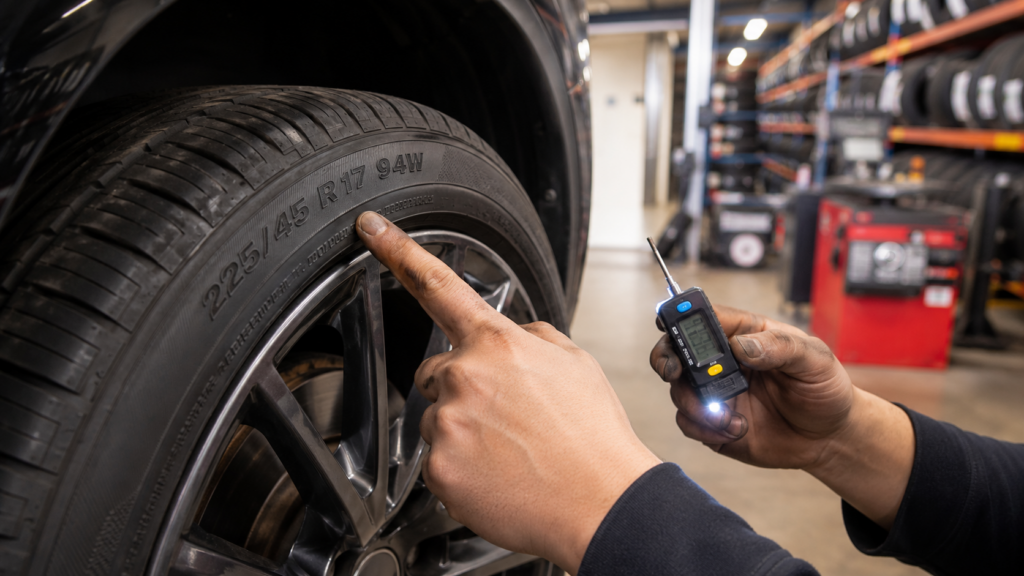
This tyre size guide Sydney drivers can use explains the numbers and letters moulded into the tyre sidewall, such as 225/45 R17 94W. Once you know how to read them, it is much easier to avoid the wrong size, wrong load rating, old stock or an unsafe replacement.
The sidewall is not just technical decoration. It tells you the tyre width, profile, rim size, load index, speed rating, construction type and, in many cases, the tyre age and fitting direction.
Key takeaways
- 225/45 R17 94W tells you size, construction, load index and speed rating.
- The DOT date code shows the tyre’s week and year of manufacture.
- Always match the vehicle placard unless a tyre professional confirms an alternative.
- NSW tyres must be in good condition and have at least 1.5 mm tread depth.
- Hot Tyres Riverwood can check your sidewall before fitting new tyres.
On this page
- Why sidewall numbers matter
- How to read 225/45 R17 94W
- How to check tyre age
- Load index and speed rating basics
- When to ask a tyre shop to check it
Reviewed: July 2026 by Hot Tyres Riverwood for Australian and NSW drivers.
Take a walk around your car and crouch down next to any tyre. You’ll see a string of numbers and letters moulded into the rubber, something like 225/45 R17 94W. To most drivers it looks like a secret code, and it’s easy to ignore right up until the moment you need new tyres, get pulled over for a defect, or try to work out whether the “bargain” tyres online will actually fit your car.
Here’s the good news: once someone shows you what each marking means, your tyre sidewall stops being a mystery and becomes one of the most useful cheat sheets on your entire vehicle. It tells you exactly what size your car needs, how much weight each tyre can carry, how fast it’s rated to travel, how old the rubber is, and even whether the tyre is safe to keep driving on.
At Hot Tyres in Riverwood, we’ve been fitting, balancing and inspecting tyres for Sydney drivers for more than 12 years, and “what do all these numbers mean?” is one of the questions we answer most often. So we’ve put together this complete, plain-English guide to reading your tyre sidewall: no jargon, no upselling, just the facts you need to make a confident decision next time you’re buying tyres or checking your car’s roadworthiness.
Tyre Size Guide Sydney: Why the Sidewall Matters
The sidewall is the flat outer face of the tyre between the tread (the part that touches the road) and the rim. Everything moulded into it is there for a reason, and most of it is legally required. When you buy a replacement tyre, matching these markings correctly isn’t optional: fitting the wrong size, load rating or speed rating can affect your handling, your fuel economy, your insurance, and whether your car passes a pink slip inspection.
Getting it right also saves you money. Drivers who understand their sidewall don’t overpay for a higher speed rating they’ll never use, and they don’t get caught out buying tyres that are technically illegal for their vehicle. By the end of this guide you’ll be able to walk into any tyre shop, including ours, and speak the language.
Tyre Size Guide Sydney: The Main Sidewall Code Decoded
Let’s start with the big one: the primary size string. Using our example of 225/45 R17 94W, here’s what every part means.
225: the tyre width
The first number is the section width of the tyre in millimetres, measured from sidewall to sidewall when the tyre is inflated and unloaded. In our example, the tyre is 225 mm wide. A wider tyre generally offers more grip and a bigger contact patch, while a narrower tyre can be lighter, quieter and slightly more fuel efficient. Common passenger widths in Australia range from about 175 mm on small hatchbacks up to 275 mm or more on performance cars, utes and 4x4s.
45: the aspect ratio (profile)
The second number is the aspect ratio, expressed as a percentage of the tyre’s width. A “45” means the sidewall height is 45% of the 225 mm width, roughly 101 mm from rim to tread. This is often called the tyre’s “profile.”
- A lower number (e.g. 35 or 40) means a shorter, stiffer sidewall, sportier handling but a firmer ride and more vulnerability to pothole and kerb damage.
- A higher number (e.g. 60 or 65) means a taller sidewall: a softer, more comfortable ride and more protection for your rims, which is why SUVs and family cars tend to run higher profiles.
This is one of the most important numbers to match when you buy. Changing the profile changes your overall rolling diameter, which can throw out your speedometer reading and, in some cases, your safety systems.
R: the tyre construction
The letter after the profile describes how the tyre is built. Almost every modern passenger and 4×4 tyre in Australia is radial, shown as R. You may occasionally see a D (diagonal/bias-ply) on older trailers or classic vehicles, or a B (belted bias). For everyday driving, you’ll see R nearly every time.
17: the rim (wheel) diameter
This number is the diameter of the wheel the tyre is designed to fit, measured in inches. Our example tyre fits a 17-inch wheel. This one is non-negotiable: a 17-inch tyre only fits a 17-inch rim. If you’re changing wheel size, for example, upgrading your alloys, the tyre size has to change with it to keep the overall diameter close to standard. If you’re not sure what your car takes, our team can check it against the manufacturer’s specification in a couple of minutes.
94: the load index
After the size comes the load index: a coded number that tells you the maximum weight each tyre can safely carry when properly inflated. It is not the weight in kilograms directly; it’s an index you read from a chart. A few common examples:
| Load index | Max load per tyre |
| 88 | 560 kg |
| 91 | 615 kg |
| 94 | 670 kg |
| 97 | 730 kg |
| 100 | 800 kg |
| 104 | 900 kg |
So a load index of 94 means each tyre can carry up to 670 kg, multiply across four tyres and you have the vehicle’s tyre load capacity. This matters enormously for utes, vans, 4x4s and anyone who tows or carries heavy loads. Never fit a tyre with a lower load index than your vehicle’s placard specifies: it’s both unsafe and a guaranteed defect at inspection. If anything, fitting a higher (reinforced or “XL”) load rating is fine, and often sensible for working vehicles.
W: the speed rating
The final letter is the speed rating: the maximum speed the tyre is certified for under ideal conditions. It’s another coded system:
| Speed symbol | Max speed |
| T | 190 km/h |
| H | 210 km/h |
| V | 240 km/h |
| W | 270 km/h |
| Y | 300 km/h |
Our example tyre (W) is rated to 270 km/h, far beyond any legal Australian speed limit. So why does it matter? Because the speed rating also reflects how the tyre handles heat, cornering and high-speed stability. Fitting a rating lower than your manufacturer recommends can affect handling and may void aspects of your insurance or fail an inspection. We cover this in much more detail in our dedicated guide to tyre speed ratings: well worth a read if you’re choosing between two similar tyres.
Put it all together and 225/45 R17 94W reads as: a 225 mm wide radial tyre, with a sidewall 45% of that width, built for a 17-inch rim, able to carry 670 kg and rated to 270 km/h. Not so mysterious now.
How old are your tyres? Reading the DOT date code
Here’s the marking most drivers have never heard of, and it might be the most important one for safety. Every tyre carries a DOT code: a serial number stamped into the sidewall that includes the week and year the tyre was manufactured.
Look for a four-digit number, usually at the end of the DOT serial, often inside an oval outline. It reads as week + year:
- 2523 = the 25th week of 2023
- 0126 = the 1st week of 2026
Why does this matter? Because rubber ages whether you drive on it or not. A tyre that’s been sitting on a shelf, or fitted to a low-kilometre car, slowly hardens and develops tiny cracks, a process called dry rot. As a general rule of thumb in Australia’s climate:
- Tyres over 6 years old should be inspected closely, even if the tread looks fine.
- Tyres over 10 years old should be replaced regardless of tread depth.
This is exactly why buying “new old stock” or cheap online tyres can backfire. You might be fitting brand-new tyres that are already several years old. When you buy from a physical shop like ours, you can check the date code yourself before it goes on the car. If you’ve noticed fine cracking around the sidewall, read our guide on what causes dry rot on tyres and get them checked sooner rather than later.
Load and pressure information
Look a little closer and you’ll find the maximum load and maximum pressure the tyre itself is rated for, usually printed in both kPa (or PSI) and kilograms. Two important points:
- This is the tyre’s maximum it is not the pressure you should run day to day.
- The correct running pressure for your car comes from the vehicle tyre placard, not the sidewall.
The placard is a small sticker, typically found on the driver’s door jamb, inside the fuel filler flap, or in the glovebox. It lists your car’s recommended tyre size and the correct cold inflation pressures for normal and loaded driving. Running the pressure the manufacturer specifies, not the tyre’s maximum, gives you the best balance of grip, wear, comfort and fuel economy. If you’re unsure how to check and set it correctly, our step-by-step guide on how to check your car tyre pressure walks you through it.
Tread Wear Indicators and Direction Arrows
NSW Government roadworthiness guidance says tyres must be in good condition, inflated to the recommended pressure and have at least 1.5 mm tread depth. You can check the official guidance on the NSW roadworthiness page.
Your sidewall (and the tread itself) hides a couple more useful markings.
Treadwear indicators (TWI)
Moulded into the bottom of the tread grooves are small raised bars called tread wear indicators. On the sidewall you’ll often see a small triangle, the letters “TWI,” or the tyre brand’s own symbol pointing to where these bars sit. When your tread wears down level with these bars, the tyre has reached the legal minimum of 1.5 mm of tread depth across the tyre in Australia. And it’s time to replace it. In practice, for wet-weather safety, we recommend replacing well before you hit that legal minimum. Our guide on when to replace your car tyres explains the warning signs to watch for.
Rotation and fitment arrows
Some tyres are directional: designed to spin in one direction only. And carry an arrow on the sidewall showing which way they should roll. Others are asymmetric, marked “OUTSIDE” and “INSIDE,” so they have to be fitted the correct way round on the wheel. Get these wrong and the tyre won’t grip or clear water as designed. This is one of the reasons professional fitting matters: when we handle your new tyre fitting and balancing, we make sure directional and asymmetric tyres go on exactly as the manufacturer intended.
Other markings you might spot
Depending on the tyre, you may also see:
- M+S: “Mud and Snow,” indicating an all-terrain or all-season tread pattern with better grip in loose conditions.
- A snowflake-in-a-mountain symbol (3PMSF): certified for severe snow use; rarely essential in most of Sydney but relevant for alpine trips.
- XL or “Reinforced”: an extra-load tyre with a stronger construction and higher load capacity.
- RunFlat, RFT, SSR, ROF, ZP: brand codes for run-flat tyres, which let you drive a short distance after a puncture. We break these down in our article on run-flat tyres.
- The brand and model name: for example the tread pattern’s marketing name, which helps you find reviews and match a replacement.
How to Use This Tyre Size Guide Sydney Drivers Can Trust
Now that you can read the code, here’s how to put it to work, whether you’re shopping with us in Riverwood or comparing options online.
- Match the size exactly (width / profile / rim diameter) to your placard or existing tyres, unless you’re deliberately doing a professionally-advised plus-size upgrade.
- Meet or exceed the load index and speed rating your manufacturer specifies. Don’t go lower.
- Check the date code so you’re not paying “new” money for old rubber.
- Decide on width and profile trade-offs: grip and looks versus comfort and rim protection, based on how and where you drive.
- Consider the tread type for your usage: touring, performance, all-terrain or budget. Not sure? Our guide on what size tyres you should buy helps you weigh it up.
If you’d rather not do the maths, that’s exactly what we’re here for. Bring the car in and we’ll read the sidewall, cross-check it against your vehicle’s specification, and recommend options that fit your car, your driving and your budget: from quality new tyres to inspected, safe second-hand tyres.
A quick word on wheel alignment
Reading your sidewall also helps you spot trouble early. If you see uneven wear: the inside or outside edge worn far more than the centre, or a feathered, saw-tooth pattern. Your wheels are very likely out of alignment. Left unchecked, misalignment quietly chews through expensive tyres and pulls your steering off-centre. If your tyres are wearing unevenly, book a wheel alignment and we’ll set the angles back to the manufacturer’s spec so your new tyres last as long as they should.
Frequently asked questions
What do the numbers on my tyre mean?
They describe your tyre’s size and ratings. In a code like 225/45 R17 94W, 225 is the width in millimetres, 45 is the sidewall profile as a percentage of that width, R means radial construction, 17 is the rim diameter in inches, 94 is the load index (maximum weight it can carry) and W is the speed rating (maximum certified speed).
How do I tell how old my tyre is?
Find the DOT code on the sidewall and read the last four digits, the first two are the week and the last two are the year of manufacture. For example, 2523 means the 25th week of 2023. In Australia’s climate, have tyres over 6 years old checked and replace any over 10 years old regardless of tread.
Can I fit a different size tyre to my car?
You should match the size, load index and speed rating on your vehicle’s tyre placard. Changing size, profile or wheel diameter affects your speedometer, handling and roadworthiness, so any change should be done as a properly calculated “plus-size” fitment. When in doubt, ask us to check it against your vehicle’s specification first.
What is the legal minimum tyre tread depth in Australia?
1.5 mm across the tread. When the tread wears level with the tyre’s tread wear indicator bars, the tyre is at the legal limit and must be replaced. For wet-weather safety we recommend replacing before you reach that point.
Does a higher speed rating mean a better tyre?
Not necessarily. A higher speed rating reflects heat and high-speed stability, not everyday quality. Fit at least the rating your manufacturer specifies, but you don’t need to pay for a rating far beyond your car’s needs.
Book a tyre check with Hot Tyres Riverwood
Understanding your sidewall puts you back in control. But you don’t have to do it alone. Whether you need new tyres, a second opinion on wear, a wheel alignment, or a pink slip inspection, the team at Hot Tyres in Riverwood is here to help drivers right across southern Sydney, from Hurstville and Beverly Hills to Bankstown, Kogarah and beyond.
For a practical tyre size guide Sydney drivers can use in person, visit Hot Tyres Riverwood and we can read the sidewall with you before fitting new tyres.
Call us on (02) 9533 6138 or get in touch here to book in. Bring your car down, and we’ll read your tyres so you don’t have to. And make sure whatever goes on next is the right fit, the right rating, and safe for Sydney roads.